
A bit of history
At the World Food Summit in 1996, La Via Campesina (LVC) launched a concept that both challenged the corporate dominated, market driven model of globalised food production and distribution, as well as offering a new paradigm to fight hunger and poverty by developing and strengthening local economies. Since then, food sovereignty has captured the imagination of people all over the world – including many governments and multilateral institutions – and has become a global rallying cry for those committed to social, environmental, economic and political justice.
In 2001, delegates from peasant, fisherfolk, indigenous peoples, civil society, and academic organisations met in Havana at the World Forum on Food Sovereignty to elaborate the different elements of food sovereignty. From 2000 onwards, campaigners against the WTO’s Agreement on Agriculture demanded public support for sustainable, family based food production and called for Priority to Peoples’ Food Sovereignty and WTO out of Food and Agriculture.
Nyéleni Global forums
The 1st Nyéleni Global forum , held in Sélingué in 2007, Mali, was a pivotal event in the global food sovereignty movement and brought together more than 500 people from 80 countries to pool ideas, strategies and actions to strengthen the global movement for food sovereignty. Named after a legendary Malian peasant woman symbolizing food self-sufficiency, it united a powerful coalition of actors, including peasant farmers, fishers, pastoralist, Indigenous peoples, rural workers, women, and youth, to exchange knowledge and strategies.
Food sovereignty implies new social relations free of oppression and inequality between men and women, peoples, racial groups, social classes and generations. Food sovereignty makes sense for people in both, rural and urban areas, and poor and wealthy countries. It is as much a space of resistance to neoliberalism, free market capitalism, destructive trade and investment, as a space to build democratic food and economic systems, and just and sustainable futures. […]
Key outcomes included the creation of the Food Sovereignty Action Agenda, which focused on promoting community control, resisting the corporate capitalist model, and strengthening food sovereignty movements through collective action. The forum also defined the Six Pillars of Food Sovereignty, emphasizing the right to healthy, culturally appropriate food, the value of food providers, the localization of food systems, local empowerment, knowledge development, and environmentally respectful production methods.The forum marked a critical step in translating the principles of food sovereignty into tangible action and global solidarity. The Nyéléni 2007 Declaration encapsulates that vision.
In February 2015, many of these same movements came together at the 2nd Nyéléni Global Forum, where they agreed upon a common definition of Agroecology. Also held in Sélingué, the forum highlighted agroecology’s roots in ancient practices and knowledge, positioning it as an alternative to the destructive industrial food production model. The forum strongly opposed the co-optation of agroecology by institutions and corporations seeking to transform it into a mere set of technologies, distancing it from its roots as a social and political movement.
Among its key achievements was the definition of the core pillars and principles of agroecology, emphasizing that it is not just a production technique but a way of life that seeks harmony between nature, humanity, and the cosmos. These principles included territorial rights, the value of Indigenous knowledge, the role of women and youth, and the importance of community-based autonomy. The forum also focused on collective action strategies, such as advocating for public policies that support agroecology, fostering knowledge exchange, empowering women, strengthening local economies, and building alliances with other social movements. It concluded with a call to action, urging people worldwide to embrace agroecology as part of a broader movement for justice, equity, and environmental harmony.
The 3rd Nyéléni Global Forum
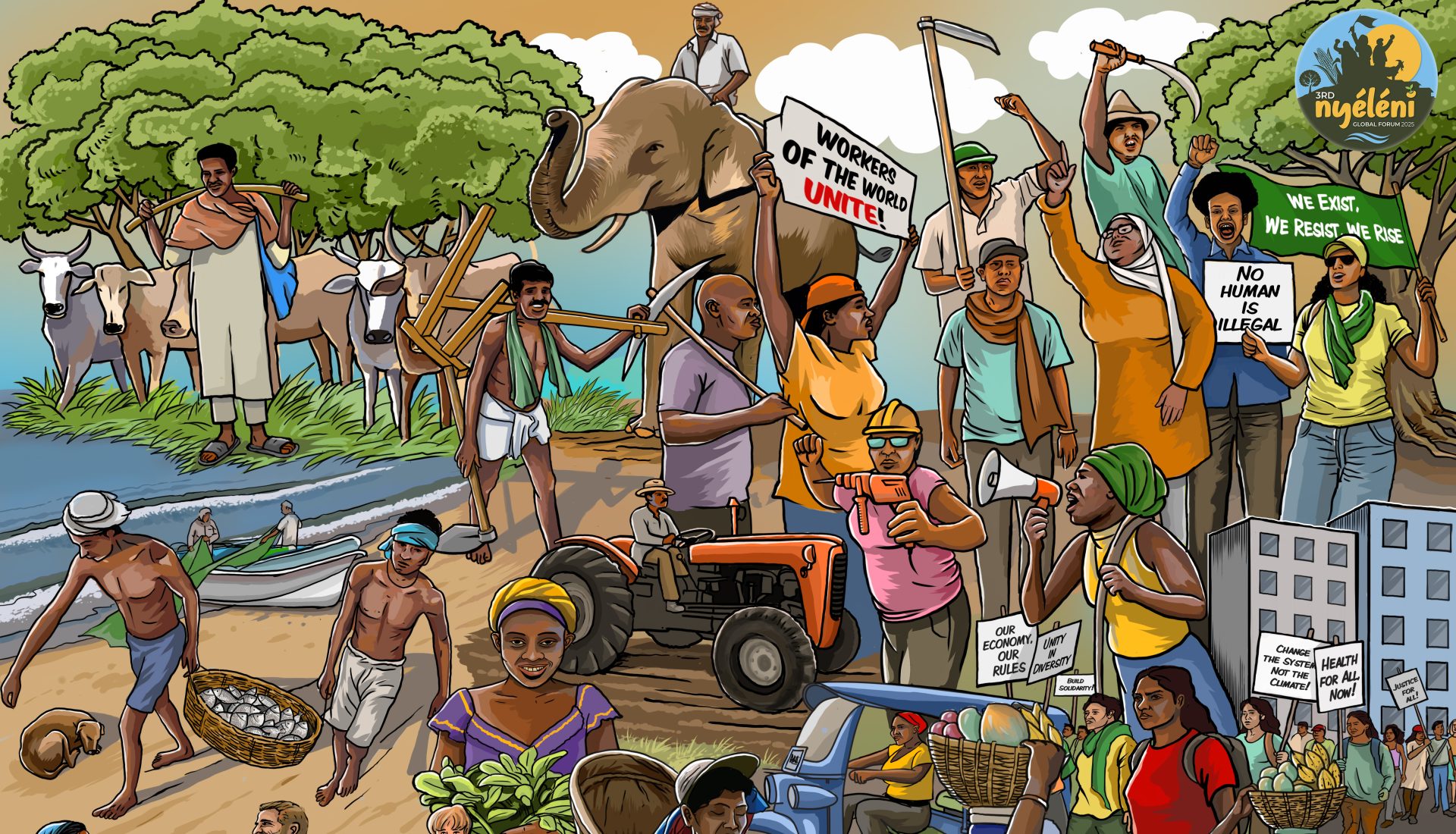
The 3rd Nyéléni Global Forum–scheduled to take place in Sri Lanka in September 2025– will bring together one of the most diverse representations of the world’s working classes. Expanding beyond its traditional base of small-scale food producers, the forum is building joint proposals and actions to confront the interconnected crises facing humanity today.
Our collective struggles are growing, now enriched by contributions from a broader range of social movements. These include efforts rooted in the social and solidarity economy, feminist economy, buen vivir, health for the peoples, energy sovereignty, a just and feminist energy transition, and the popular control and management of forests and other territories. Together, we are forging a path toward the systemic transformation our world urgently needs.
Systemic Transformation is now, or never!
If you want to support this process, whether by donating or collaborating, please contact us at communications@foodsovereignty.org or via our social media on Facebook, X, Instagram, and YouTube. If possible, please contact us in Spanish, French, or English, but we welcome messages in any language.