Nyéléni Global Forum
Nyéléni Virtual Gallery – Axes

Nyéléni Virtual Gallery – Axes

Nyéléni Virtual Gallery 2025: A Living Tapestry

This is not a traditional gallery. It is a living tapestry woven with our memories, struggles, and dreams. Here, there is no beginning or end, only journeys. Here, bodies, territories, grief, and radical imagination are honored. In the spirit of Nyéléni, we weave pathways toward food sovereignty, global justice, and systemic transformation. Welcome to this living convergence.

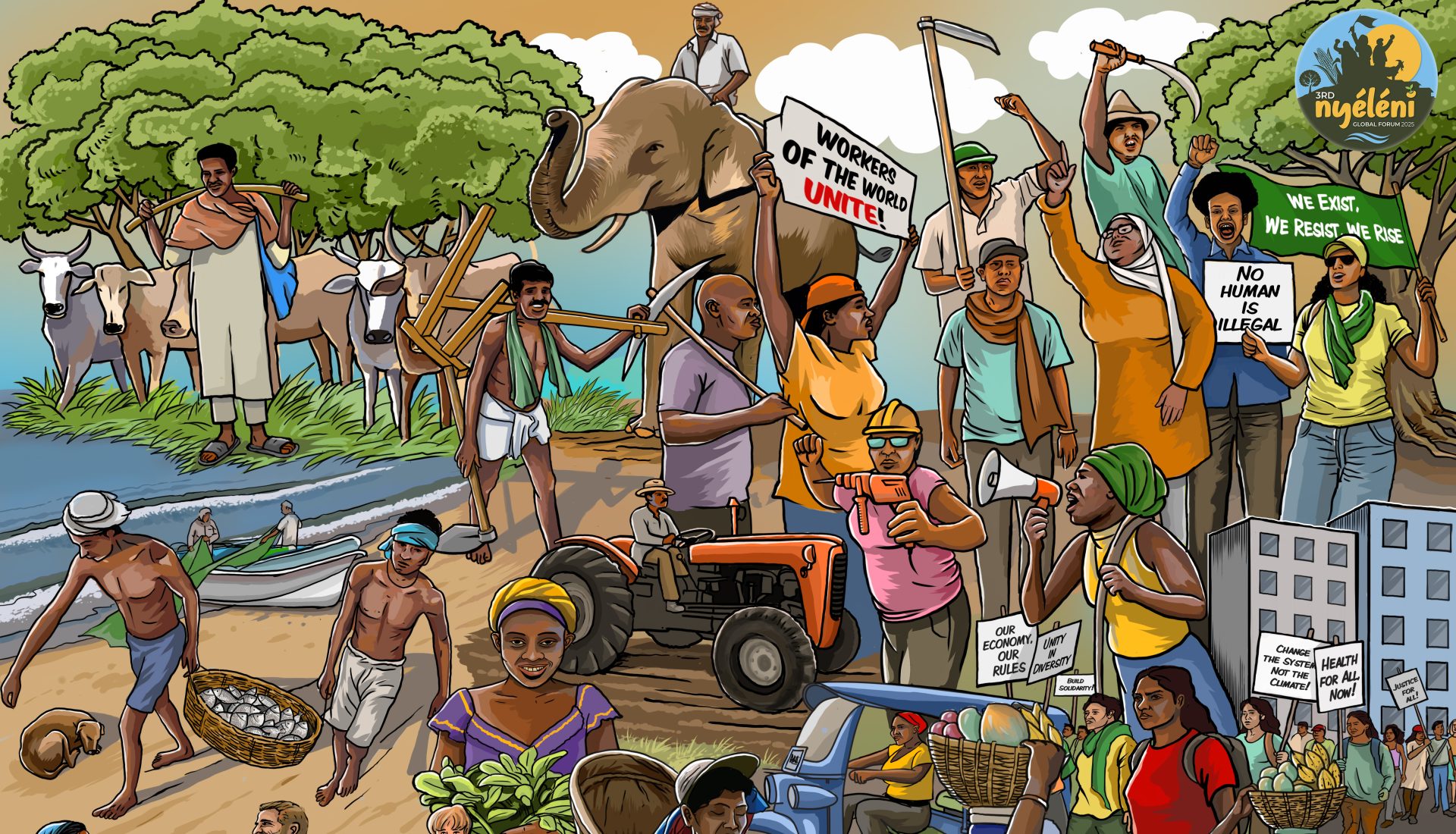
Build peoples' economies

In the ruins of an extractive, patriarchal and colonial system, peoples are weaving new economies — where life, not profit, is at the center. Where care becomes resistance, and solidarity, a force of reconstruction. These are not dreams for the future — they are practices alive in our territories, rooted in ancestral knowledge, feminist visions, food sovereignty and communal strength.

To build peoples’ economies is to recover the fabric of life — through just trade, territorial markets, public services, workers’ rights, and grassroots alternatives that challenge corporate power. It is to reclaim the right to produce, care, feed, and live in dignity. It is to shift the narrative and dismantle what oppresses us — together, from below.

Music
"Takkai" and "Kagani, Kagani" by The Mamaki Boys (Niger)
A heartbeat of ancient drums meets the raw pulse of underground hip hop. In Takkai, the Mamaki Boys turn tradition into fire—sampling the rhythms of the village, the swing of ancestral dances, and the wisdom of proverbs carried through generations. The result is not nostalgia, but a living, breathing movement: defiantly local, fiercely global. The track’s words are both challenge and invitation: to protect culture from erosion, to dance as our elders danced, and to work without pause for a future rooted in dignity. Between verses, you can hear the sound of the takkai stone striking—sharp as memory, steady as resistance. Emerging from Niger’s early-2000s cultural renaissance, this “tradi-moderne” sound was born when Aziz Tony, Bachou Issouf, and Salif André invited elder musicians into their studio to fuse duma and kalango with the cadence of rap. It is music that greets everyone—men, women, young, old—with the same open hand, saying: Come forward. Step into the rhythm. The struggle is ours to carry together.
“Takkai” by The Mamaki Boys
“Kagani, Kagani” by the Mamaki Boys
“El aborrajao” by Oye sebas
“Dos de agua, una de arroz” by Oye sebas
"El Aborrajao" and "Dos de agua, una de arroz" by Oye Sebas (Colombia)
With the pulse of Latin American folklore, Oye Sebas turns everyday life into living cinema. In "El Aborrajao", we follow Juan and Adelina—two street vendors whose song carries the scent of home-cooked food from their countryside kitchen to the bustling streets of the city. Their melody is more than an advertisement; it is the hymn of thousands of families who keep tradition, dignity, and survival alive through the selling of food made by their own hands. "Dos de agua, una de arroz" shifts the scene but keeps the same thread: a grain that has nourished humanity for millennia, connecting distant lands through shared meals. In his mother’s words—“Learn this recipe and you will never starve”—the song folds love, resilience, and ancestral wisdom into a simple instruction. Both tracks weave music with food, linking the soil where it grows to the tables where it is shared. Oye Sebas invites us to see that in every recipe, every street call, every handful of rice, there is a story of justice, community, and popular power waiting to be heard.
THE STRUGGLE IS COLLECTIVE
Vreni Knödler (Germany) & Miriam Knödler (Sweden)
Roots press into the earth. Branches reach for the sky. Between them, words bloom—resistance, presence, strength, resilience, love and joy, respect, autonomy, equality, community. These are not just words. They are seeds, carried from the voices of the Sowers of Life and Resistance School of the Alliance for Food Sovereignty of the Peoples of Latin America and the Caribbean. They speak of movements that rise like forests after fire—where feminism, youth, and diversities weave into the same canopy, sheltering each other from the storms of oppression. This image does not ask to be observed from afar. It asks you to step inside, to feel the hum of collective struggle under your feet, and to remember: liberation is a landscape we cultivate together.
"Seeds for Everyone" by Fiona Morgan (Australia)
In washes of watercolour and delicate ink, seeds drift across the page—gifts of life, meant to be shared. They carry a quiet truth: what we notice, we care for; what we dream, we bring into being. This work is a meditation on abundance and interconnection, rooted in the belief that sharing is not charity—it is survival, written into our very evolution. Created on the beautiful lands of the Gumbaynggirr people, whose sovereignty was never ceded, the piece honours the ancient custodianship of this place and pays respect to Elders past, present, and emerging. With every seed passed from one hand to another, Fiona Morgan invites us to reclaim an ancestral knowing: that we are not owners of life, but guardians and co-creators of its endless cycles.
"Nyéléni" by Tilly Gifford (Scotland)
Carved into the grain of the lino, an entire world unfolds: farmers tending the land, animals grazing under a generous sky, roots reaching deep into the soil. Above, the sun smiles with a human face, the moon cradles the night, and stars scatter like seeds across the heavens. Butterflies and birds drift between earth and sky, carrying the whispered name Nyéléni—a tribute to the Malian woman whose story embodies the struggle for food sovereignty and dignity. This print is both a landscape and a manifesto, where every root, wing, and ray of light insists on the inseparable bond between people, land, and the cosmos. Tilly Gifford’s work invites us to see not just a pastoral scene, but a vision of harmony born from resistance—a reminder that the world we cultivate is the one we live in.
"Rooted Traditions" by Emilia Cordero and Elias Ramirez (USA)
In a quiet corner of rural North Carolina, hands meet soil, herbs, and one another. Tradiciones enraizadas follows a group of women who have built more than a cooperative—they have cultivated a living archive of agricultural knowledge and ancestral herbalism. From gardens fragrant with medicinal plants to worktables where natural ointments, soaps, and shampoos take shape, every step is infused with shared memory and mutual care. This is not just commerce; it is culture sustained through collaboration, healing, and the refusal to let tradition fade. Through intimate storytelling, Emilia Cordero and Elías Ramírez show that rooted traditions are not relics of the past, but seeds for the future—seeds that thrive when planted in community and tended with love.

Building peoples’ democracy, peace and internationalist solidarity

In the face of rising authoritarianism, war and dispossession, we weave resistance from tenderness and rage, from the right of peoples to live with dignity and decide their own future. We reclaim a democracy built from below—collective and diverse—that dares to imagine worlds beyond the state, the market and imposed borders.

We refuse to normalize genocide, hunger as a weapon, or repression as law. In every resisting territory, an alliance blooms—a free word, a revolt. Against impunity, we affirm justice. Against hatred, internationalist solidarity. Against domination, the right to rebel. Our democracy is popular, feminist, peasant, Indigenous, migrant—and it is built through art, memory, and everyday struggle.

Digital Art
"Seeds of Pachamama" by Majez/Ángel Román Huayhua Yancapallo (Peru)
In a world where technology too often bends toward greed, seeking to dominate the earth and erase ancestral wisdom, Seed of Pachamama emerges as an act of resistance. Through vibrant imagery, Majez plants seeds that carry memory, critical thought, and the spirit of collectivity—a principle as old as the first harvest and as vital as the soil itself. Each pixel becomes a reminder that growth is never solitary; it springs from shared roots, from the voices and hands of peoples who have always understood that the future must be cultivated together. This work calls us back to the source, to protect the earth not as a resource to be consumed, but as a living mother whose gifts demand respect, reciprocity, and care.
"Racism is not up for debate, it must be fought" by Mabel Karoll Medina Valenzuela (Peru)
This powerful poster stands as a call to action in the ongoing fight against racism—a struggle that unites us all. Created within the framework of Emakume Migratu Feminista Sociosanitariak and the #21M Anti-Racist movement from the Basque Country, it demands justice and dignity for migrants. With the striking phrase "Fire to the colonial order” blazing across the design, and banners calling for “Registration for all” and “Regularization now”, the artwork confronts systemic exclusion rooted in colonial legacies. More than a message, this piece is a rallying cry: racism is not a subject for debate, but an injustice to be actively challenged, uprooted, and defeated—together.
Palm of memory by Vicky Shahjehan (Sri Lanka)
In this hennaed hands. Palestine is traced in fragile white lines—yet unbroken. One hand, crackd like stone, bears the silence of suffering. Another, splattered red beneath the stars, evokes the blood of a people under genocide. These hands remind us our own hands, too, can rise—to hold, to resist, to stop killing.
"Révoltons Nous" by Wook (France)
This fierce track is a rallying cry for revolution and profound change. Wook challenges listeners to rise up and reject passivity in the face of political corruption and social injustice. Through sharp critiques of a political class that manipulates laws for their own benefit, the song exposes the hollow nature of elections and the impunity enjoyed by elites. It questions a system where the powerful speak of human rights while suppressing dissent, and where the common people are treated like obedient sheep. More than lamenting the status quo, Révoltons Nous calls for collective awakening and direct action. It urges everyone to open their eyes, reclaim what is theirs, and turn quiet frustration into a roaring revolution—one that will break through the clouds and demand real justice for future generations. A powerful manifesto of social discontent, this song embodies the spirit of resistance and the urgent need for systemic transformation.
“Révoltons Nous” by Wook
“Peace in W” by Win’AB
"Peace in W" by Win’AB (Togo)
With a voice both tender and unyielding, Win’AB offers Peace in W as a musical prayer for a wounded world. Layered over soulful rhythms, his words reach beyond borders, calling for peace, love, and the unity needed to heal our shared home. The song mourns the illusions of equality and the hollow promises of democracy, naming the fraternal bonds broken by greed, oppression, and violence. Yet it refuses despair. Instead, Win’AB dreams aloud of a new world—like the one Martin Luther King envisioned—where the lion and the lamb might share the same plate, and every person can reach their fullest potential. At its heart, Peace in W is an urgent invitation to change our mindset, to replace division with solidarity, and to join in the struggle for justice and food sovereignty. It reminds us that peace is not a fantasy, but a choice we make together—and a future we can still build.
El Barzón Against "Tequila Cuervo" by Ignacio Mirelles (México)
Beneath the blazing Jalisco sun, the agave fields stretch endlessly— rows of spiny blue hearts, each holding the sweat of generations. Yet behind the beauty lies a battle. In 1995, the peasants of El Barzón del Agave rose against the grip of the tequila industry, against the duopoly that dictated prices and futures. They blocked factory gates, their machetes and banners standing guard over a dignity too long undervalued. These images capture the clash between the vast machinery of global brands and the rooted hands that plant, cut, and carry the weight of the harvest. In Mirelles’ lens, the struggle becomes visible: faces weathered by sun and injustice, landscapes marked by both abundance and scarcity, moments where solidarity turns the dust of the road into the drumbeat of change. It is the story of who holds power over the land—and of those who dare to take it back.
"In tribute to the firefighters" by Jean Aristide Tchiombiano (Niger)
In Tchiombiano’s novel, we meet women and men who have given their bodies to the nation. Trained to master their emotions and face urban and industrial crises, these firefighters move as one—an angelic battalion united in spirit, complementing each other through relentless battles against fires, floods, and unforeseen disasters. Their service to the people in moments of deepest need forms the silent foundation of civil life, ensuring safety without distinction, protecting all equally. Amid the city’s shadows—where chaos and violence lurk—their presence restores order, peace, and hope. They are the calm within the storm, the support of collective well-being. Yet beyond their outward work, this story sings of the profound solidarity within their ranks: an unbreakable commitment to saving lives, honoring the sacred dignity of every human being. In this universal act of care, the novel becomes a call to unity, mutual support, and the tireless defense of life in all its forms.
"Hope, Architecture and Space" by Delia Albarrán/Casa Matla, Ecosystemic Architecture (Mexico)
Filmed in São Paulo and Rio de Janeiro, this video carries the voice of the Matlatzinca Valley. Through kites and fleeting skies, Delia Albarrán reflects on architecture and space as territories of resistance—against a capitalism that perpetuates racial, class, gender, and species injustice. Esperanza is not just a song, but a call to act, to lift solidarity and justice into the wind.

Food sovereignty and agroecology

We sow rebellion in the soil and care in our harvests. Agroecology is not a method—it is a living practice, born from ancestral memory, collective strength, and a deep reverence for life. It nourishes ecosystems and communities alike, weaving together justice, biodiversity, and autonomy.

When rooted in food sovereignty, agroecology becomes a force of liberation—defending our right to define what we grow, how we grow it, and for whom. It is through this vision that we break free from corporate chains and build dignified food systems, grounded in self-determination and solidarity.

Paint and liquid mediums
"Siembra Gráfica" by the youth of the 1st Peasant Youth and Communication Camp for Sovereignty, together with Colectivo CompaS (Colombia)
Born from ink, stencil, and collective imagination, Siembra Gráfica embodies the voices of 23 young peasants from the mountains and valleys of Santander. Guided by CompaS, these works sow images of food, energy, technological, and cultural sovereignty. Each poster is more than art—it is a political act, a reaffirmation of peasant identity, and a seed of resistance carried by the hands of a new generation.
"Victory of Love" by SESAM (Democratic Republic of Congo)
With rhythms rooted in the earth and voices rising like seeds in the wind, Victory of Love sings the arrival of a new time. It is a hymn to food and medicinal sovereignty, to agroecology as the path of life. This song celebrates the harvest as a common paradise, proclaims that the seeds must remain in the people’s hands, and honors even the smallest beings that sustain the soil. More than music, it is a call to cultivate minds, to dream together, and to create a joyful victory of love.
SESAM – RDC
Franck BRIDA, Gozino de Tché and Room’s
"Standing up for peasant agroecology" by Franck BRIDA, Gozino de Tché and Room's (Ivory Coast)
Created at the annual YaALITIA Boot Camp on peasant agroecology, organized by JVE Côte d'Ivoire, this song, through its words and melodies, raises awareness and promoted sustainable farming, respectful of nature and full of hope for rural communities.
"Roots of Sovereignty" by Lucas Sebastián Worsdell (Switzerland)
Roots of Sovereignty invites us to slow down and trace the layers beneath rural landscapes, listening to stories of territory, autonomy, and resistance. Born in Nicaragua and grown with collaborators in Puerto Rico, the project honors the resilience of small agroecological producers and traditional crops that survived Hurricane María. In an increasingly digital world, the power of the analog contrasts sharply with dominant norms and demands. Through photo-voice and analog photography, these images reclaim time, reflection, and care, revealing the deep roots of autonomy and the pluriversal connections that sustain both communities and ecosystems.
Latin American Stories: Women and Mother Earth by Red Latinoamericana de Agroecologías para la Paz
This podcast series brings to life the voices of women across Latin America, weaving tales of love, memory, and care for Mother Earth. Born from a collective artistic journey, each story explores traditional medicine, ancestral knowledge, the rhythms of daily life, and the struggles and triumphs of women in their territories. Through narrative, music, and voice, these podcasts cultivate circles of care and ecofeminist solidarity, imagining a future rooted in agroecology, cultural memory, and the protection of all forms of life. A celebration of resilience, connection, and collective healing across the continent.
"No Woman, No Food?" by Vina Hiridjee & Emilie Langlade (France)
Eating is political. What we place on our plates shapes the world. The agro-industrial system, greedy and toxic, thrives on profit while ignoring the planet. This podcast amplifies the voices of seven women across four continents—farmers, activists, guardians of threatened culinary heritage—who are rewriting our relationship with the land. Stories of resistance, reverence, and culinary rebellion rise like the Earth itself, calling for a Food Revolution.
"The Milpa System: ancestral agroecological practices in Guatemala" by by Elwin Eberardo Sucup Osorio, Cándido Leoncío Cortez Morales & Melany Dayana Chen Sic
This short film takes us into the rich agricultural heritage of the Maya Achí Indigenous people in Baja Verapaz, Guatemala. It highlights an ancestral cultivation system known as milpa, a sustainable and biodiverse practice interweaving corn, beans, and squash.
"La Pella Soberana" by Caladebro (Spain)
A cauliflower, or pella in La Rioja, becomes a quiet messenger of sovereignty. Traveling through Madrid, it passes from hand to hand—sometimes met with confusion, sometimes with knowing care. Through this simple vegetable, the film explores how sovereignty lives in our daily choices, in the instincts we follow, and in the love we hold for ourselves and for the natural world. A pella needs no words to exist—it simply is.

Land, territories and Agrarian Reform

Our first territory is the body. Our first horizon is the land. From the forests to the rivers, from the mountains to the coasts, we defend the right to live well, in harmony with all beings. We carry the wounds of dispossession, but also the strength of ancestral struggles and collective dreams of justice.

Territories are not resources—they are alive. Every tree, every wave, every seed speaks of resistance. Against land grabbing, concentration, and corporate control, we affirm: agrarian reform is not a policy, it is a path to dignity. Without it, the hands that feed the world will remain far from the soil they nurture. Land must belong to those who make it live—the struggle for territory is the struggle for life, free, diverse, and rooted in the commons.

Digital Art
"Cultivate or Die" by Chardonnoir (Indonesia)
In Chardonnoir’s vision, campesinos rise like giants, their hands and harvests both shield and sword. Free from Pests, Cultivate or Die echoes in the rhythm of their labor, while To Cultivate is to Struggle pulses in every furrowed field and defiant gesture. They defend the earth, nurture life, and reclaim sovereignty, transforming cultivation into an act of rebellion, resilience, and hope.
"Millet Stem in Full Earth" by Mariam Mamadou Moustapha Adji (Niger)
In Millet Stem in Full Earth, Mariam Mamadou traces the quiet power of nature. Acrylic strokes reveal life emerging from darkness, as fissures in the earth give rise to unseen growth. Stems and flowers rise, embodying resilience, nourishment, and the hidden strength beneath the soil. The abstract forms speak of cycles, sustenance, and the subtle efficacy of life rooted in the earth.
“Nace el día” by Abora project (Spain)
“Nace el día” is a song of dawn and awakening — a hymn to movement, freedom, and inner liberation. The rising light becomes both guide and witness, carrying the rhythm of time and the promise of renewal. With each breath and each step, the song calls us to walk, to release, to embrace the burning journey of life. It is a celebration of the body in motion and the spirit in flight — an ode to living fully, as each day is born anew.
“Souffle de la terre” by Denis Borghi (France)
“Le souffle de la terre” is an acoustic melody born from the breath of the earth itself. Its tones carry both hope and struggle, resonating with the energy of life in all its forms. Each note opens a path toward a possible world — where humans and non-humans live in complementarity, weaving together the promise of a new society in harmony with the land.
“Repaysanisation” by Matteo Orselli (Belgium)
"Repaysanisation" is both song and poem, a visceral cry of body and heart. It unveils the fractures of the Western way of life, while opening a path toward food sovereignty through a collective return to the land. More than a melody, it is a call to reclaim the commons — the Earth as ecosystem, as mother, as horizon. With words that sow resistance and renewal, it reminds us that repaysanisation is not only an act of farming, but an act of life.
"The young shepherds" by Miraviento (Peru)
In the highlands of Cusibamba, Cusco, Miraviento captures the quiet resilience of the young shepherds. Children guide their flocks across the mountains, tending to life itself through hours of care and labor. Amid the long days, stories are shared, laughter rings, and small hands weave the rhythms of community, sustaining both flock and family.
"The Struggle of landless peasants" by Serikat Petani Indonesia & IPC
“The struggle of landless Peasants” gives voice to the young and the resilient. In Tukdana, Indramayu, children of the land and their communities rise against threats and displacement, reclaiming what is theirs. Through participatory storytelling, they capture their own lives, their labor, and their resistance—turning fields into sites of struggle, survival, and hope. Amid violence and injustice, the camera follows hands that sow, feet that tread the earth, and hearts that insist: the land belongs to those who nurture it.

Climate justice and energy sovereignty

False solutions—carbon and biodiversity offsets, REDD+, debt-for-nature swaps, and other schemes—cast shadows that deepen the crisis and silence the earth’s true voice.
But real solutions rise like dawn: a just transition centering those who have long carried the burden, reparations that restore what colonialism and greed have taken, community-led energy, agroecology, and policies that breathe climate justice into life.

Energy sovereignty blooms quietly alongside—rooted in the hands of peoples, in respect for nature’s rhythms, and in the shared right to clean, public, and democratic energy that fuels hope and sustains futures.

Paint and liquid mediums
"Sécheresse et mort" by Vito Manaudo (France)
In Sécheresse et mort, Vito Minaudo gives us a sunflower standing alone, shedding its petals into fractured soil. The painting captures a landscape of drought and silence, where heat devours the earth and life struggles to endure. The sunflower becomes both witness and mourner, embodying the fragility of existence in the face of global warming and the urgent cry of a world losing its breath. These images echo the origins of today’s climate crisis, where the destruction of soil and community feeds a cycle of exploitation. They remind us that confronting these harms is inseparable from imagining just, sovereign futures for food, energy, and the Earth itself.
Siembra Gráfica" by the youth of the 1st Peasant Youth and Communication Camp for Sovereignty, together with Colectivo CompaS (Colombia).
In July 2024, in the mountains of Santander, peasant youth gathered to sow art as resistance. With CompaS, they turned stencil and ink into tools of memory. From their hands were born Sin agua no hay café and ¿Y el agua? — visions where iguanas, rivers, and cow-humans cry out against extractivism and the theft of water. These posters remind us: to defend water is to defend life, territory, and energy sovereignty. In their colors shines a call—let communities, not corporations, guide the future of the commons.
"The Industrial Food Chain" by Becky Green (England)
Through three stark illustrations, Becky Green reveals the fractures of the industrial food chain: monocultures erasing farmlands, factories devouring local economies, and meat production turning life into commodity.
"Save the planet" by Vicky Shahjehan (Sri-Lanka/ India)
The earth trembles beneath an endless wave of harm, born not of life itself, but of a system of domination that scars all who dwell upon her.
"Molecular Manipulation" and "Geo-engineering" by Catherine Dizon (Philippines)
In Molecular Manipulation and Geo-engineering, Catherine Dizon imagines a world where human hands reach beyond their limits, bending the planet and its skies to their will. The first work reveals a planet no longer guided by natural rhythms, but programmed by human control—life’s cycles conditioned, re-engineered. The second shows giant hands grasping the climate itself, surrounded by technologies of geo-engineering that distort and desolate. Together, these digital visions ask: what becomes of Earth when humanity claims to master it?
“La danse du champignon” by Denis Borghi (France)
In "La danse du champignon", Denis Borghi draws us into the secret rhythm of the earth. Mushrooms, often unseen, emerge as active participants in life’s dance. Their hidden mycelial networks sustain ecosystems, connect plants, and recycle matter—a quiet testament to life’s interconnection. In a world where human activity disrupts these processes, their presence reminds us of the resilience and adaptability of nature, even in the face of environmental degradation
Poem on environmental health by Didier Castillo, Enita Juarez, Heydi Varela (Honduras)
Written by three young voices from rural Honduras, this poem is a heartfelt call from the land itself. It speaks of rivers, fields, and forests silenced by fire and neglect, and urges us to care for nature as we care for our own bodies. With innocence and clarity, these young authors remind us that every drop of water, every plant, every bird is part of the web of life—and that protecting it is protecting ourselves.

Nature speaks, and her cries are directed at the human who destroys her.
The fields are sorrowful, melancholy rising to the surface, abandoned by the little birds whose masterful notes once uplifted our hearts and brought peace to our ears.

Gone are the flowers whose fragrance once carried pure love, gone the crops humans once harvested, gone the beauty embodied by all wildlife.
Season by season, life diminishes—only dryness, sadness, hunger, and suffering remain.

No more fires—would you burn your own lungs for greed and ambition?
Stop the destruction, or humanity will dig its own grave and forge its own torment.

You would not poison your own blood, nor cut your veins—so why do it to her without remorse?
Protect the air you breathe, each drop of water, every crop, every fruit, every medicinal plant. They are the sustenance of all beings, and without nature, we are nothing.

She is so beautiful that I would not hesitate for a second to represent you in her.
She is a temple, she is home—care for her, protect her as such.

By: Didier Castillo, Enita Juarez, Heydi Varela

"Land of Dreams" by Rebeca Rubi Martinez (Mexico)
In Land of Dreams, Rebeca Rubi Martinez Sosa takes us to Oaxaca, where the Mestizo community tends ancestral knowledge and nurtures Indigenous seeds. These seeds are more than heritage—they are a shield against climate chaos, a way for youth to reconnect with the earth, and a reminder that safeguarding our roots is part of building climate justice. Through their hands and care, the land tells its story, resilient and alive.

Peoples' rights, Health For all

We unravel the tales that separate us from nature—colonial lies that justify plunder. In their place, we weave health from Buen Vivir, where human life flows with the pulse of the Earth and all beings.

Care is our first act of sovereignty, rooted in ancient wisdom and sacred knowledge, protected from greed and held in trust.

We dream of medicines and nourishment as shared gifts—free from patents and profit—and a world where justice and compassion replace the war on drugs. Health is a collective journey, born from the land, the body, and our common struggle.

Digital Art
"Much respect to those who grow your food” by Alejandro Ríos (colombia)
These works honors the hands that cultivate the earth. In his striking graphics, peasants sow, tend, and harvest, reminding us that every meal carries the labor, care, and resilience of those who feed the world.
"Feet that Feed the World” by Mahak&Manju Agrawal (India)
«Feet that Feed the World» honors small-scale farmers, their weathered feet tracing the paradox of feeding others while often going hungry. It celebrates their labor and the shared right to nourishment and well-being.
Art and agriculture by Charlotte Le Roux (France)
«Les Cueilleuses d’Angéliques» (The Angelica Harvesters) celebrates women in agriculture, while «Tout est lié» (Everything Is Connected) evokes childhood wonder and nature’s symmetries: a single umbel unfolding into countless blossoms, scents to breathe, a return to innocence.
"Tajaraste Del Mar" by Abora project (Spain)
This song is a powerful call from the sea. Through voices of concern and rhythm, it speaks of polluted waters, sickness, and years of political inaction, turning anger into song. If we cannot stop the harm, at least our voices will rise—singing for the ocean, demanding change, and reminding us that the people themselves can stir the tide.
Human Nature by Martin Crespi (Argentina)
Martin Crespi’s works invite us to reflect on the food we consume, revealing how it can nourish—or harm—our bodies. Through his art, we confront the delicate balance between health and habit, and are offered keys to understanding our deeper relationship with Nature.
"A Sick City" by Jean Aristide Tchiombiano (Niger)
«A sick city» (Une ville malade) is a story of a city weighed down by neglect and loss. Through the struggle of Bouli and the wisdom of the elder Manzo, personal fight turns into collective care, showing how solidarity and shared responsibility can heal a community. A tale of resilience, awakening, and the quiet power of working together.
"A Time for the Garden" by Carmen P.G. Granxeiro (Spain)
This documentary invites us into a world where seeds became imperative when stepping outside was not advised. Around the garden that shaped their daily lives, Amaia and Carmen, together with their pets, navigate a story led by the rhythms and wonders of the plant world.