

Main ideas taken from the case study “Community Supported Agriculture – blurring the boundaries between producers and consumers, urban and rural, and furthering our commons and commoning : furthering change!” published on Socioeco.org
After the World Day of Social Justice last 20th Feb and during this month of series dedicated to food and human rights, we highlight the crucial role of food sovereignty and the Social Solidarity Economy (SSE) as drivers of change towards more equitable and sustainable societies. The human right to healthy food cannot be separated from the struggle for just, democratic and sustainable food systems. In this framework, initiatives such as the Oma Maa cooperative in Finland and the movements converging in the Nyéléni 2025 process show viable ways to transform the relationship between the countryside and the city, between producers and consumers, and between the economy and life.
Oma Maa: A cooperative model of food transformation
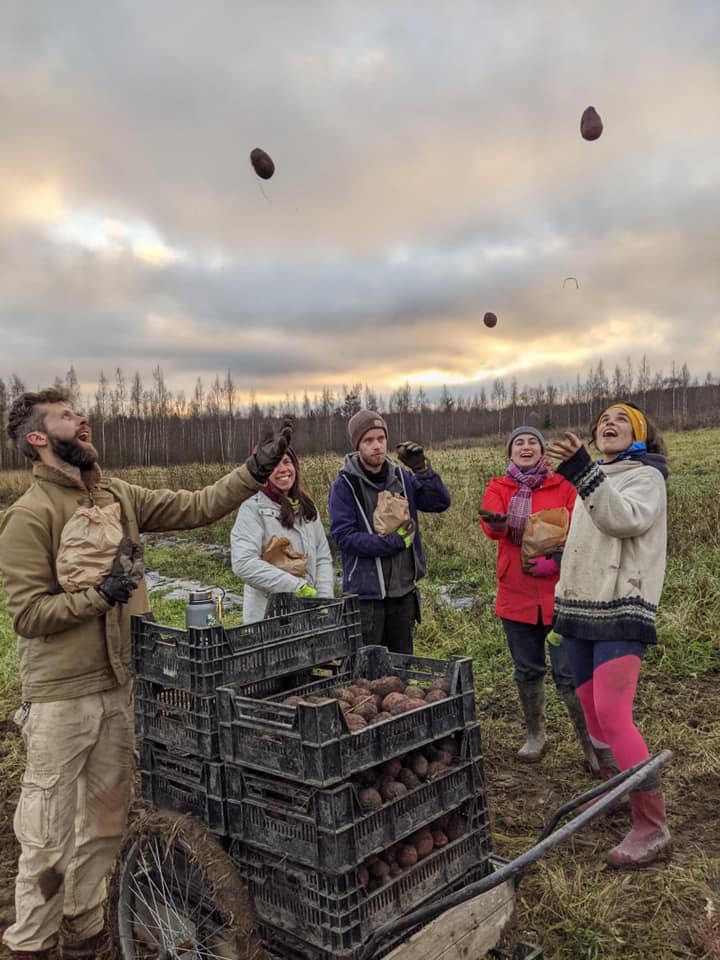
The Oma Maa cooperative is an inspiring example of how food sovereignty can materialise in solidarity-based economic models. Located in Finland, this farming community operates under a Community Supported Agriculture (CSA) scheme, where consumers not only buy food, but actively participate in the production process and in the decisions of the cooperative. In Europe alone, URGENCI [the international grassroots network of all Regional and Local Solidarity Associations for Agroecology (LSPAs)] has documented more than 1 million people.
Oma Maa is not just a food producer; it is a platform for agro-ecological education, economic democracy and environmental regeneration. Its model is based on:
- Agro-ecological production: cultivate in a diversified way, regenerating the soil and promoting biodiversity.
- Equitable access to food: members purchase weekly baskets of healthy, local produce.
- Community participation: consumers and producers co-govern the project, strengthening the links between town and country.
- Solidarity economy: the cooperative prioritises social and environmental viability over profit with the aim to ensure a fair income for farmers.
This model demonstrates that it is possible to work towards food systems based on cooperation and mutual support, as opposed to agribusiness based on exploitation and monoculture. Truth be said, financial sustainability remains a real challenge on an everyday basis due to among others, the lack of involved individuals and the considerable workload. Luckily, the vision and values remain strong.
Food Sovereignty and Nyéléni 2025: An interconnected global movement
Food sovereignty is not just a slogan, but a political project built by thousands of communities, peasant organisations, indigenous peoples, cooperatives and SSE networks around the world. Since its launch, the Nyéléni Forum 2007 has been a pillar in the struggle for the right of peoples to define their own food systems, in opposition to neoliberal policies of free trade and corporate control.
The Nyéléni 2025 process is a new phase of global articulation in which diverse movements – peasant, indigenous, feminist, agroecological, SSE and feminist economics – are building a common roadmap to address the food, ecological and social crises. Key intersections include:
- The right to food vs. the commodification of food: local, sustainable and rights-based production clashes with the accumulation logic of large agribusiness corporations.
- Feminisms and food sovereignty: women and diversities are essential in food production and commons management, but face inequalities in access to land and resources.
- Peoples’ autonomy vs. extractivism: in the face of land grabbing and the agro-export model, the Nyéléni movements promote productive systems that strengthen food autonomy.
- SSE and food sovereignty: agricultural cooperatives, local markets and fair trade networks are key strategies to consolidate food sovereignty in the framework of an alternative economy.
Nyéléni 2025 seeks to consolidate alliances between these movements, reinforce common strategies and strengthen political advocacy so that food sovereignty is translated into real public policies.
Social Solidarity Economy: The model that articulates these struggles
The Social Solidarity Economy (SSE) is the framework in which many of these struggles converge. This economic model challenges the extractivist and accumulative logic of conventional capitalism, proposing instead an economy centred on collective well-being, equity and sustainability. Members of Nyéleni are the Intercontinental Network for the Promotion of SSE (RIPESS), from which Oma Maa takes part through the European network (RIPESS EU).
The SSE in food is expressed through:
- Agricultural and consumer cooperatives: such as Oma Maa, which distribute food without intermediaries, strengthening local production.
- Fair trade networks and solidarity markets: ensuring decent prices for producers and fair access to food for consumers.
- Community seed banks and agroecology: protecting biodiversity and guaranteeing sovereignty over seeds and agricultural knowledge.
- Solidarity finance: micro-credit systems, local currencies and ethical investment models that allow communities to control their own economic development.
This intersection between food sovereignty and SSE is key to ensuring a just, democratic and sustainable food system, where communities have the power to define their own food and economy.
For Social Justice based on Food Sovereignty and SSE
The World Day of Social Justice reminds us that the right to healthy food is inseparable from the struggle for the dignity of peoples and respect for the commons. Experiences such as Oma Maa and the movements gathered at Nyéléni 2025 show us that another model is possible: one based on solidarity, cooperation and respect for nature.
From the Nyéléni Forum, we call for the strengthening of solidarity networks and the construction of economic alternatives that allow us to move towards more just and sustainable societies.