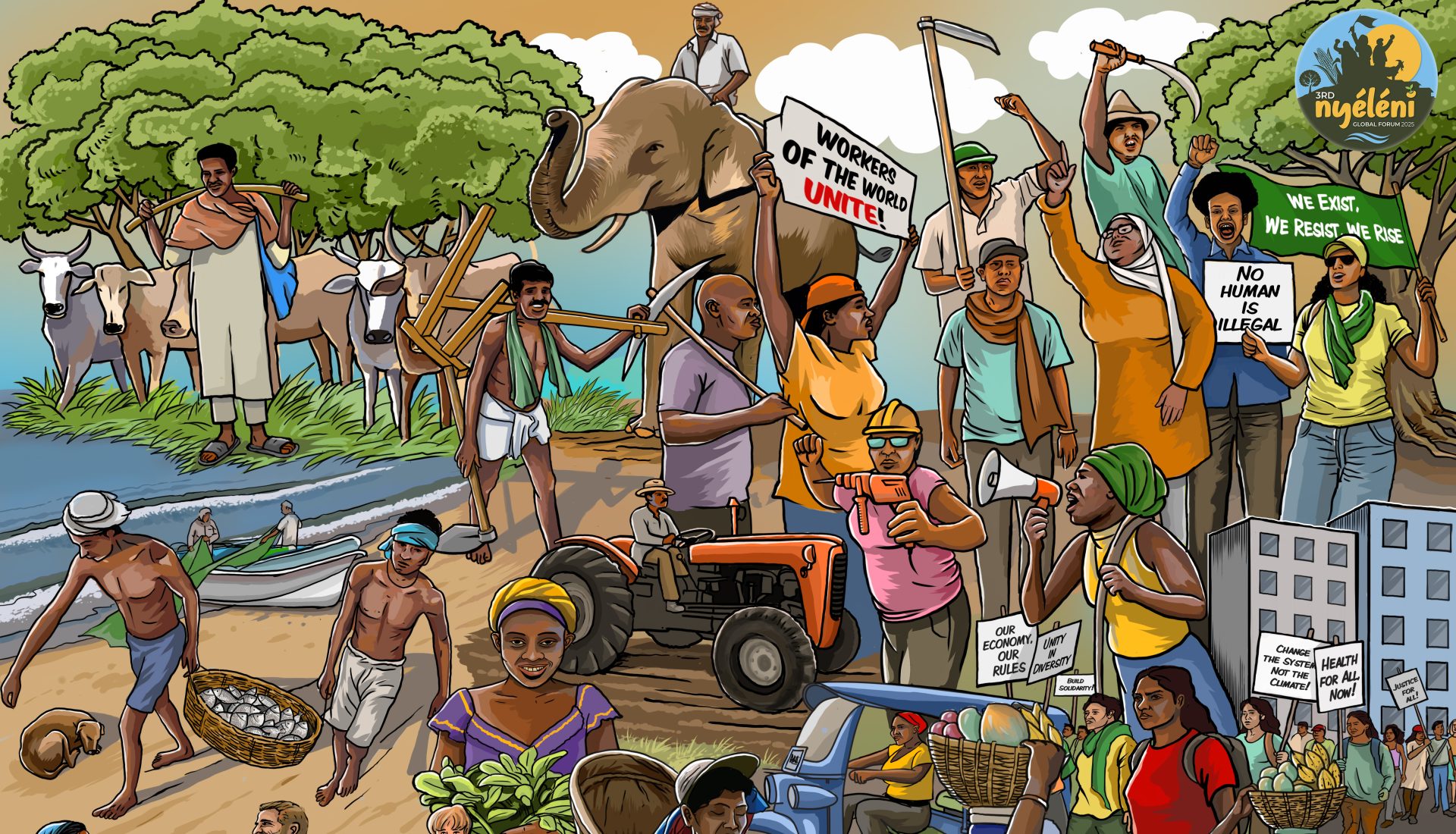
Food Sovereignty and Agroecology

IPC releases its position paper on agrarian reform ahead ICARRD+20

Le Comité international de planification pour la souveraineté alimentaire publie son document de position en amont de la Conférence internationale sur la réforme agraire et le développement rural – CIRADR+20, appelant à une réforme agraire transformative fondée sur la souveraineté alimentaire.Le Comité international de planification pour la souveraineté alimentaire publie son document de position en amont de la Conférence internationale sur la réforme agraire et le développement rural – CIRADR+20, appelant à une réforme agraire transformative fondée sur la souveraineté alimentaire.

Popular movements gather in Colombia for 2nd international agrarian reform conference

Between February 24 and 28, representatives of grassroots movements and Indigenous peoples from around the world will gather in Cartagena, Colombia, for the2nd International Conference on Agrarian Reform and Rural Development (ICARDD+20). Delegates from more than 70 countries are expected to attend.

Global Social Movements Rally Around ICARRD+20 as Struggles Over Land, Commons, and Territories Intensify

As geopolitical conflicts intensify and corporate control over land, territory and natural resources deepens, social movements, and Indigenous Peoples from across the world are rallying behind the Second International Conference on Agrarian Reform and Rural Development (ICARRD+20) – being hosted by the Government of the Republic of Colombia and to be held in Cartagena, Colombia, from 24 to 28 February 2026.

“Agroecology is more than farming, it’s a path to justice” – A conversation with Musa Sowe

Musa Sowe, Second Vice President of ROPPA (Network of Farmers’ and Agricultural Producers’ Organizations of West Africa) and Africa representative in the International Planning Committee for Food Sovereignty (IPC), has long been at the forefront of grassroots agroecological movements. Speaking from the Global Forum for Food Sovereignty in Kandy, Sri Lanka, he shares how agroecology has reshaped lives in his community, from farming practices to power structures.

Nyéléni as Territory, Process, and Methodology – A conversation with Martin Drago

This interview with Martín Drago, coordinator of the Food Sovereignty program at Friends of the Earth International and member of the global steering committee, highlights what is at stake in this historic moment. For Martín, Nyéléni in Sri Lanka is not an endpoint but a milestone — a space to validate and advance a joint political agenda that dismantles oppression, resists fascism and neoliberalism, and puts democracy and the rights of peoples at the center. It is a call to deepen convergence across movements and regions, to forge hope in times of crisis, and to build the power needed for systemic transformation from the ground up.

Respect, Diversity, and the Fight for Food Sovereignty – A conversation with Mariann Bassey

Food is more than what ends up on our plates—it carries culture, identity, and the wisdom of generations. At the heart of the 3rd Nyéléni Global Forum, delegates from all over the world gather to share stories, strategies, and visions for a just and sustainable food system. In this conversation, we hear from Mariann Bassey, who represents the African region and the Respect and Diversity group at the 3rd Nyéléni Global Forum, about how these principles connect to food sovereignty, the power of communities to resist corporate control, and the ways traditional knowledge continues to shape the fight for nourishing, culturally rooted food.

Right to Food: Path Towards Agroecology and Food Sovereignty – A conversation with Paola Romero

On the doorstep of the 3rd Nyéléni Global Forum, to be held in the city of Kandy, in the heart of Sri Lanka, Paola Romero, Director of FIAN Colombia, political scientist, and expert in gender, feminism, and food sovereignty, shares her reflections in an interview. In it, she explains how they have historically worked to advance the human right to adequate food and nutrition, a commitment intertwined with the promotion of food sovereignty and agroecology—fundamental pillars to ensure justice and sustainability in food systems.

The right to see things as a Commons (and the potential for systemic change through the working towards Food as a Commons)

For many of us, the word ‘commons’ will bring up associations to natural resources as land, and perhaps to earlier times when the commoners, the lay people as peasants were called, were allowed to use the commons to find firewood and gather food. In Europe, the enclosure of those commons with the onset of privatisation in the 18th century put an end to this. The end of these communal forms of agriculture led to the precarization of women’s lives in particular as it destroyed their means of livelihood and weakened their social power. But the commons can actually be referring to so much more, in fact to a paradigm shift taking us in the very opposite direction of capitalism.

From April 17 to the 3rd Nyéléni Global Forum, let’s rise for people’s sovereignty!

While a multipolar world is on the horizon, the demands for the Right to Land and the Comprehensive and Popular Agrarian Reform, Food Sovereignty and denunciations against criminalization and persecution of social leaders, remain in force and active as the fundamental basis of historical struggles that have brought victories to the peasant movement.

World March of Women : ON THE ROAD TO FOOD SOVEREIGNTY

Today, in the run-up to the 3rd Nyéléni Global Forum, we make an urgent call to unite and act collectively against the capitalist system that continues to advance in a destructive and exploitative manner. It is crucial that we center solidarity, mutual respect, and self-criticism in our struggles, as only through these principles can we build a more just and sustainable future for all. The global challenges threatening our food sovereignty and social justice cannot be ignored.