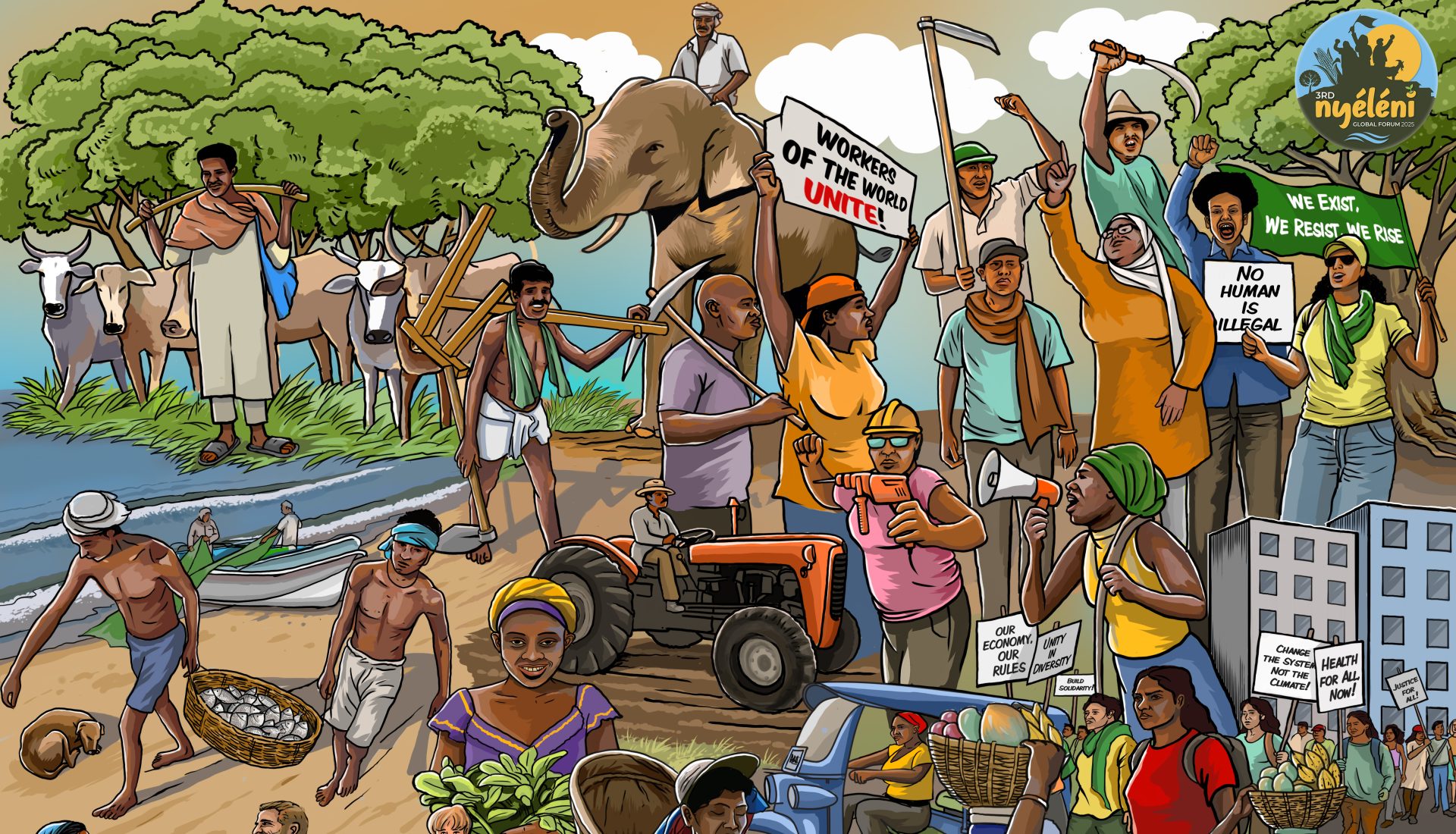

Food Sovereignty and the Social Solidarity Economy towards Social Justice
Main ideas taken from the case study “Community Supported Agriculture – blurring the boundaries between producers and consumers, urban and rural, and furthering our commons …

Main ideas taken from the case study “Community Supported Agriculture – blurring the boundaries between producers and consumers, urban and rural, and furthering our commons …
As part of our special February series dedicated to food and human rights, we interviewed Geneviève Savigny, a peasant and the president of the UN Working Group on the Rights of Peasants and Other People Working in Rural Areas (2024-2025). In this conversation, we discuss the recent formation of this working group and its role in implementing the United Nations Declaration on the Rights of Peasants and Other People Working in Rural Areas (UNDROP).
In this interview, Geneviève Savigny highlights the importance of the new UN working group, the challenges in implementing UNDROP, and the role that peasant movements and the Nyéléni Forum can play in this process.
The fight against agrotoxics in Paraguay dates back to the arrival of genetically modified soybeans, which came bundled with a technological package. This package includes the use of fertilizers, insecticides, pesticides, and other desiccants. Combined with other elements, it has sparked continuous confrontation with the peasant population. While the intensity of this resistance has fluctuated over time, it has been shaped by the economic and political power wielded to impose the agribusiness model in the country. This aggressive model took hold forcefully, displacing entire communities.
In the arid landscapes of East Africa, Sami, a young man returns to his village with his family and a degree in water research. With his wife, Achieng, they share a vision of progress that respects tradition and nurtures the land.
Article by REAS, the Network of Networks of Alternative and Solidarity Economy of Spain published in La Revista Soberanía Alimentaria (here you can read its …
As part of our month dedicated to Agroecology, Nyéléni is pleased to share the following article, originally published on the Agrotóxico Mata: Permanent Campaign Against Pesticides and for Life website. This initiative brings together the MPA, the CONAQ, the MPP, the MST, the PJR, Vía Campesina Brazil, and many other movements and civil society organizations across Latin America.
This animation film succinctly explains the Food Sovereignty principles. It explains how Food Sovereignty places us – the peasants and all other small-scale food producers- at the heart of food systems, instead of powerful corporations, by building on the principles of solidarity, collectivism and social justice. Food Sovereignty defends our past, present and future generations, and is an alternative to a destructive and harmful industrial food system.
At the 2nd Nyéléni Global Forum, held at the Nyéléni Center in Mali in February 2015, delegates from diverse organizations representing small-scale food producers—peasants, Indigenous Peoples, family farmers, fisherfolk, pastoralists, and rural workers—gathered to affirm Agroecology as a pillar of Food Sovereignty.
In February 2007, 600 delegates from every corner of the globe gathered in Mali, uniting diverse voices across society with a shared passion for agriculture and food justice. This historic meeting reaffirmed the right to food sovereignty, defining its deep economic, social, ecological, and political impact. It marked the beginning of a global movement dedicated to securing food sovereignty as a fundamental right for all.


You must be logged in to post a comment.