
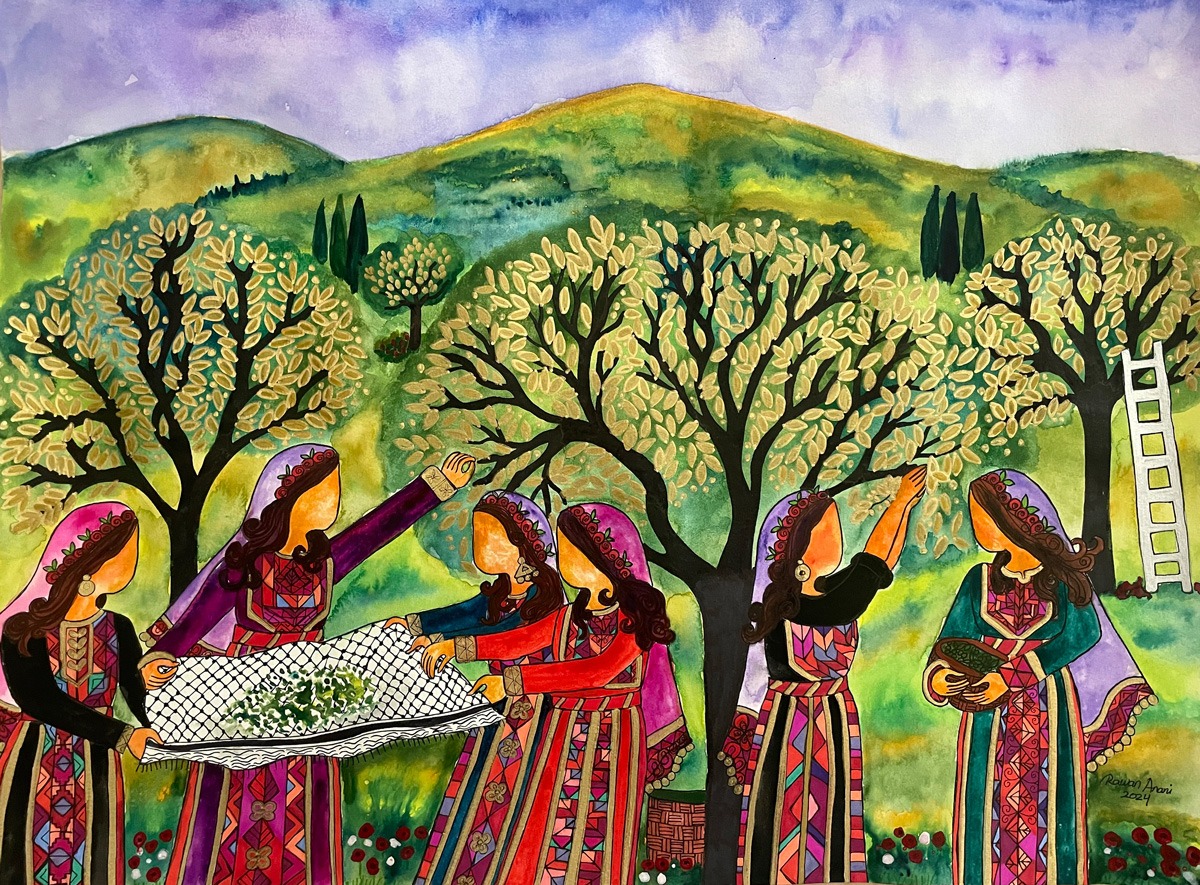

Article by REAS, the Network of Networks of Alternative and Solidarity Economy of Spain published in La Revista Soberanía Alimentaria (here you can read its latest issue, whose cover is the image used in this post, by Rawan Anani). It was also shared by RIPESS Europe, the European Network for the Promotion of the Social Solidarity Economy, and is now disseminated on this platform by RIPESS Intercontinental . The struggle goes on, these important words are still very topical in this month of December in the Nyéléni process – for Agroecology and corporate co-optation.
January 2022_ REAS Network of Networks joins the declaration promoted by the magazine Food Sovereignty ‘ For a food system based on agroecology and food sovereignty “ and invites the REAS networks and the entities and individuals that make up the Solidarity Economy movement to support and disseminate it in favour of ”a new food system based on the foundations of peasant agroecology, food sovereignty and solidarity, cooperative and feminist economy’.
This declaration has several objectives. Firstly, to broaden and deepen the rural, agrarian and food debate in order to make explicit the root of the problem: the capitalist system. On the other hand, it is necessary to measure the number of collectives and people who share what is expressed below. In the face of confusion, the appropriation of terms and false solutions, it is important to make clear which political foundations are immovable. Finally, we are convinced that this declaration will give impetus to new initiatives for the articulation of a new food system.
We, the undersigned, consider ourselves as informed, aware, critical and committed citizens, linked in various ways to rurality and food.
We are concerned about the current situation and look forward in a context of uncertainty in the face of a food model with fewer and fewer people in the countryside and totally dependent on external inputs and limited energy, designed with parameters of profit accumulation and not to offer healthy food to the whole population or to keep our rural world alive.
We are also concerned about the biased debate that exists and, for this reason, we feel it is obligatory to contribute elements that are central to achieving what any society longs for: preserving the environment of which we are a part and guaranteeing a dignified life for all the living beings that inhabit it.
WE DENOUNCE THAT:
- Neoliberal policies are responsible for the situation of the primary sector. The abandonment of farms and farmsteads has destructured local economies and the rural social fabric; a large part of the farmers and livestock breeders who maintain their activity do so according to a model that allows them very little autonomy and decision-making capacity.
- This capitalist food system generates violence against people. Its companies take advantage of vulnerable people to employ them in precarious conditions, as we see in greenhouses or slaughterhouses; the banks increase their profits with the growing indebtedness of family farming and livestock farming; trade policies allow large supermarkets to pay below production costs to small-scale farms and ranches.
- Like other contemporary production systems, the food system is based on the domination and subjugation of nature. Industrial meat production is an example of this because of the animal abuse and the environmental and social impacts it causes in our rural environment, but also because of its entire production chain, based on the abuse of fossil fuels and the plundering and grabbing of land in the global south destined for the production of cereals for animal feed.
- This domination and exploitation is exercised on a global scale without taking into account the limits of existing resources and materials, projecting a linear growth which, on a limited and finite planet, is fictitious. We are already seeing this in the scarcity of raw materials driving up the price of fertilisers and therefore foodstuffs, in the loss of soil fertility as it is exploited year after year for intensive crop production, and in the pollution and depletion of aquifers in many of the areas where crops are grown for export.
- Maintaining these dynamics generates suffering in peripheral territories, the so-called sacrifice zones, resulting in precarious living conditions, population displacement and migration, the breakdown of community networks, and the loss of identity and knowledge rooted in the land.
- This is not only happening in southern countries, but also in our villages. The processes of rural population loss have to do with the economic and food system, and it is essential to bear this in mind when we work to stop them. Repopulation at any price is not acceptable, it is about taking care of the territory while respecting its identity and its memory, aware that in the villages lie many keys to face a post-capitalist future.
- Most of the proposals of the different governments and the administration in the face of the climate emergency in the food sector do not entail substantial changes and are only disguised ways of perpetuating privileges under the label of ‘sustainable’. Let’s stop idealising technological solutions. It is not only about healthy food that does not pollute, it is about redistributing wealth and generating autonomy, community and dignified lives by taking care of the earth.
- At the same time, some agricultural organisations and trade unions in the sector seem more concerned with maintaining their structures than with looking after the future of their members. It is surprising to see them alongside the employers, insisting on the same productivist dynamics that have led the countryside to the current situation, when they should be firmly demanding a transition within the framework of agroecology that offers security to the peasantry that persists and the peasantry that is yet to come.
Finally, the current context, partly produced by all of the above, has led to the proliferation of extreme right-wing movements with totalitarian ideological tendencies that claim a homogenising idea of rurality, based on attitudes such as intolerance and supremacism, and that maintain harmful and limiting stereotypes for the rural.
WE DECLARE THAT:
- There is an enormous amount of evidence, studies and testimonies of all the suffering that capitalist societies have caused in recent decades. Dynamics have been generated that have led to the fact that, today, decisions that have direct consequences on our lives depend more on a dominant and wealthy elite than on the will of the people.
- Antagonistic production models cannot coexist. We need a firm political commitment from governments and public administration to progressively make agroecology the hegemonic model, facilitating and accompanying reconversion in the areas of production, regulations, training, marketing and public procurement.
- More than ever, we are convinced that it is possible and urgent to build a new food system based on the foundations of peasant agroecology, food sovereignty and solidarity, cooperative and feminist economy, in a society that rejects hatred and welcomes dialogue and diversity.
- In fact, many of us are already building this on a daily basis, in our professional, personal or activist spheres, and we will continue to do so with more conviction than ever, with or without the support of our governments and public administrations, generating networks and shared learning. We are aware, however, of all that remains to be deconstructed at a personal and collective level, in our own mentalities, the result of the society in which we have been educated.
- The countryside continues to face different threats, from energy or livestock megaprojects to gentrification, but also discourses that claim to defend it with the intention of preserving individual, exclusionary and corporate privileges.
We know that we are part of a global critical mass that today constitutes a crack of hope in the face of the disaster of capitalist society. The change of course can begin with food, the primary sector and the rural world.