
A bit of history of the food sovereignty movement
A brief outline based on the contextualisation offered by Judith Hitchman (RIPESS Intercontinental board member and Urgenci, member of the international facilitation group of the Nyéléni global forum process) during the Nyeleni Europe and Central Asia meetings in Istanbul, 2024.
A reading of the history of the food sovereignty movement could trace back to the student protests of the 1960’s around civil rights, and to how in the 1990’s with corporations gaining more control, many more social movements came to be born. This was the period of the demonstrations in Seattle against the WTO when agriculture was also included in the WTO – and when food became a commodity. This period equally gave rise to the birth of the food sovereignty movement, as well as to the Social and Solidarity economy movement, in 1997, in Peru.
The food sovereignty movement grew further as a response to the globalisation of agribusinesses and agricultural policies affecting peasant farmers in the South who had to compete against cheap exports from hyper-productive, highly subsidised European and American agriculture. Small-scale farmers needed to develop a common vision and campaign – to defend their livelihoods and participate directly in the decisions impacting their lives.
La Via Campesina, the world’s largest social movement, composed of some 200 million small-scale farmers’ organisations, rural workers, fishing communities, and landless and indigenous peoples globally put forward in 1996 the concept of food sovereignty first; and brought it to the public debate during the World Food Summit of the UN in 1996. Food sovereignty was defined as “the right of peoples to healthy and culturally appropriate food produced through ecologically sound and sustainable methods and their right to define their food and agriculture systems.” The concept of food sovereignty places agricultural producers and consumers at the core of the debate.
The International Planning Committee for Food Sovereignty – born out of struggle and giving birth to action: Nyéléni
The movement at that point in time did not yet have a voice at the Food and Agriculture Organisation of the UN (FAO) until it became further organized globally into the International Planning Committee for Food Sovereignty (IPC). Born out of struggle, the IPC played a big role in the democratisation of the institutional process. It was instrumental in reforming the Committee on World Food Security to incorporate different civil society constituencies in the discussions around food security through the Civil Society and Indigenous Peoples Mechanism of the Committee on World Food Security. The various constituencies participate in the entire policy-making process, but do not vote on policy decisions, as this is the prerogative of States; there is also a framework at the FAO for bi-annual consultations with civil society. The IPC thus came to actively engage in advocacy and policy at UN level, with efforts being geared to the reclaiming of solutions being in the peoples hands, and to stand up for Food as a Human right, as a commons and not a commodity.
The IPC has not only been tackling institutional processes but also the organisation of action. Ten years after the World Summit in 1996, a landmark Nyéléni Food sovereignty forum was organised in Mali in 2007, bringing together some 500 delegates from all continents and constituencies, to strengthen and deepen the concept of food sovereignty. The name of the Forum is in itself a tribute to a peasant farmer woman in Mali who was called Nyéléni, and who fought for the rights of peasant farmers, especially of women peasant farmers in Mali already a few hundreds years ago. The forum set a framework for the growing food sovereignty movement. The outcome of the meetings was the Nyéléni Declaration, laying out the contours for a vision and an action agenda around food sovereignty, to be shared internationally.
Alongside the decentralisation of the Food and Agriculture organisation of the United Nations (FAO), a decentralisation of the IPC also took place. The IPC took on a regional structure, and so there is the Nyéléni European and Central Asia food sovereignty movement, Nyéléni ECA – a regional articulation of civil society and indigenous people working towards the realisation of food sovereignty.
In 2011 the first Nyéléni Europe forum took place in Krems, Austria, and a second European Forum was held in 2016 in Kluj-Napoca, in Romania. In 2015, many of these same movements came together at the Nyéléni Global Forum for Agroecology, where they agreed upon a common definition of Agroecology as a key element for the construction of food sovereignty. In 2018, the ten elements of agroecology were adopted by the FAO during its second symposium on Agroecology in 2018 (Solidarity economy being one of them)
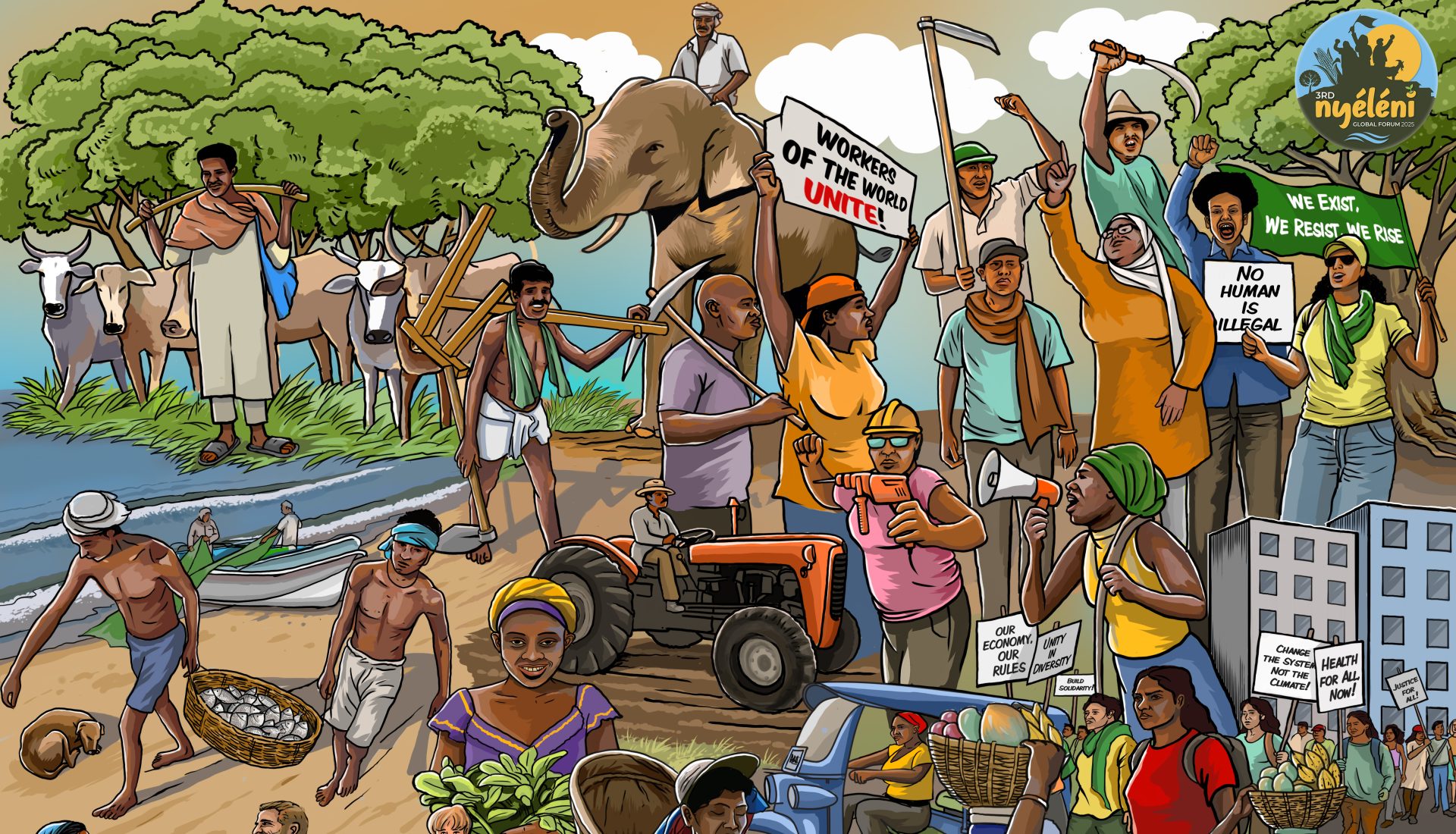
Currently, the IPC is in the process of organising towards the 3rd Nyéléni Global Forum in September in Sri Lanka, in order to readdress strategy and to reorganise and strengthen the movement. This third forum is focusing strongly on the building of new alliances together with movements that are not traditionally part of the food sovereignty movement, including movements working around issues of public health and climate justice as well as solidarity economy building at large, and wants to offer a space for political formation on the convergence of global struggles for systemic transformation.


