
The Kandy Declaration: A Collective Roadmap for Systemic Transformation
The Kandy Declaration calls on movements everywhere to act in unity, defend the commons, and transform global governance so that it serves people, not profit.

The Kandy Declaration calls on movements everywhere to act in unity, defend the commons, and transform global governance so that it serves people, not profit.
This 3rd edition follows the historic Nyeleni Forums in Mali (2007 and 2015) and seeks to build momentum towards a collective vision of systemic transformation—from the grassroots, for the planet, and for future generations.
A daily coverage of the main outcomes from the global forum for systemic transformation
Sri Lanka is undergoing one of the most complex economic recoveries in its history. The country’s financial collapse in 2022 was precipitated by a toxic mix of unsustainable borrowing, poor fiscal management, and external shocks.
Mass protests erupted under the banner of Aragalaya, a broad-based citizens’ movement demanding accountability, economic justice, and an end to political corruption.
Musa Sowe, Second Vice President of ROPPA (Network of Farmers’ and Agricultural Producers’ Organizations of West Africa) and Africa representative in the International Planning Committee for Food Sovereignty (IPC), has long been at the forefront of grassroots agroecological movements. Speaking from the Global Forum for Food Sovereignty in Kandy, Sri Lanka, he shares how agroecology has reshaped lives in his community, from farming practices to power structures.
This interview with Martín Drago, coordinator of the Food Sovereignty program at Friends of the Earth International and member of the global steering committee, highlights what is at stake in this historic moment. For Martín, Nyéléni in Sri Lanka is not an endpoint but a milestone — a space to validate and advance a joint political agenda that dismantles oppression, resists fascism and neoliberalism, and puts democracy and the rights of peoples at the center. It is a call to deepen convergence across movements and regions, to forge hope in times of crisis, and to build the power needed for systemic transformation from the ground up.
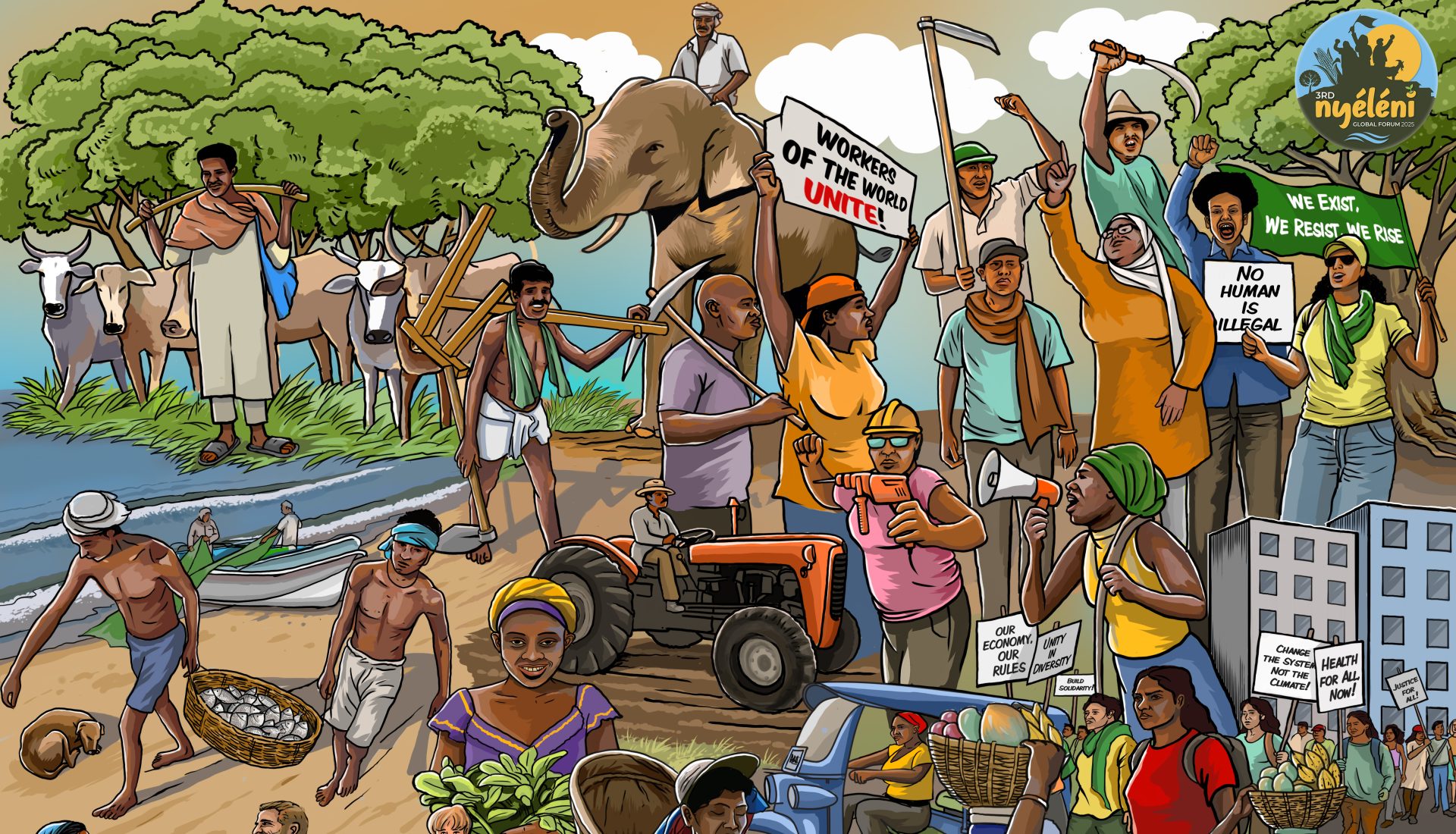
As part of the journey toward the 3rd Nyéléni Global Forum, we are sharing the latest poster, which represents the convergence of all sectors and movements participating in the process: small-scale food producers, Indigenous Peoples, pastoralists, food chain workers, daily wage and migrant laborers in urban and rural areas, feminist and climate justice movements, advocates for social and solidarity economies and health for all, consumer groups, and other service and manufacturing sector workers. This third poster visualizes how these diverse struggles and transformative proposals intertwine, showing the collective strength in building people-led systemic change. It serves as a graphic reminder that agroecology, food sovereignty, climate justice, and the commons are strengthened when social movements organize and act together.
In our latest episode, we chat with Dražen Šimleša from Croatia’s Green Network of Activist Groups and RIPESS Europe about what a just economy really means today—and how it’s already being built. From fair wages and democratic workplaces to sustainable local economies and global solidarity, Dražen gives us a grounded, practical view of how solidarity economy works in real life.
Food is more than what ends up on our plates—it carries culture, identity, and the wisdom of generations. At the heart of the 3rd Nyéléni Global Forum, delegates from all over the world gather to share stories, strategies, and visions for a just and sustainable food system. In this conversation, we hear from Mariann Bassey, who represents the African region and the Respect and Diversity group at the 3rd Nyéléni Global Forum, about how these principles connect to food sovereignty, the power of communities to resist corporate control, and the ways traditional knowledge continues to shape the fight for nourishing, culturally rooted food.
On the doorstep of the 3rd Nyéléni Global Forum, to be held in the city of Kandy, in the heart of Sri Lanka, Paola Romero, Director of FIAN Colombia, political scientist, and expert in gender, feminism, and food sovereignty, shares her reflections in an interview. In it, she explains how they have historically worked to advance the human right to adequate food and nutrition, a commitment intertwined with the promotion of food sovereignty and agroecology—fundamental pillars to ensure justice and sustainability in food systems.


You must be logged in to post a comment.