
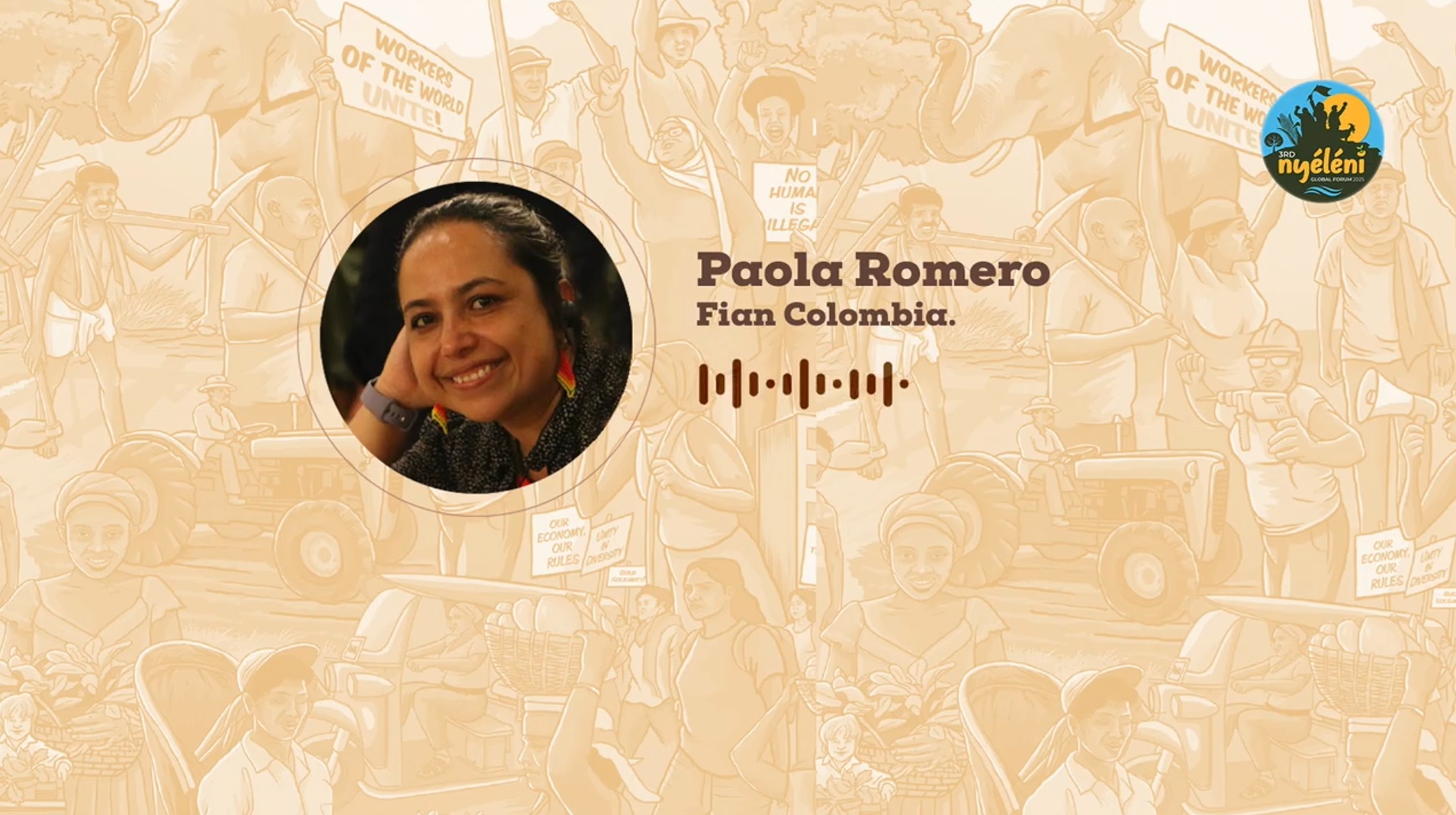

On the doorstep of the 3rd Nyéléni Global Forum, to be held in the city of Kandy, in the heart of Sri Lanka, Paola Romero, Director of FIAN Colombia, political scientist, and expert in gender, feminism, and food sovereignty, shares her reflections in an interview. In it, she explains how they have historically worked to advance the human right to adequate food and nutrition, a commitment intertwined with the promotion of food sovereignty and agroecology—fundamental pillars to ensure justice and sustainability in food systems. Read and listen to the full interview below.
Let’s talk about food as a human right.
“We believe it has been a legal interpretive framework in the defense of human rights. Food is placed at the center as a fundamental axis, as an economic, social, and environmental right with deep connectivity to other rights and a fundamental interdependence to ensure care, human dignity, education, land, and water; to build the dignity of peoples, to ensure that peoples do not suffer hunger, to free peoples from hunger.
So we believe that the human right to food is a fundamental political element for enforceability within the legal framework at different levels, both territorial, national, and international. This has even opened the doors to advance toward much deeper concepts such as food sovereignty, and to stronger recognition tools like the UNDROP and other binding instruments recognizing human diversity, the rights of nature, and non-human beings—those common goods that make food possible.
At the same time, how does the human right to food interact with discussions on agroecology and food sovereignty?
The human right to food legally opens the discussion around food and is recognized by states.
When agroecology begins to be addressed, the human right to food positions itself as a tool that enhances agroecology; indeed, the two mutually strengthen each other. Agroecology is a political, technical, and epistemological practice that allows the construction of possible relationships and alternatives for building communities and society.
And the human right to food harnesses this to strengthen the way food is produced, but it doesn’t stop at production and recognition. It encompasses the entire spectrum of availability, access, and production. Agroecology also emphasizes that food should be produced by those who work it—not with ultra-processed foods—and it also focuses on human, social, economic, and cultural relationships that recognize the knowledge and autonomy of peoples. This deeply connects with the right to food because it acknowledges the decision-making power of individuals, communities, and peoples. Here I link it with food sovereignty because it deepens and shows the importance of autonomous decision-making from communities and territories, which also enriches the human right to food and connects it with the recognition that this right allows people to live with dignity and cultural integrity. Both food sovereignty and agroecology strengthen this bond, also highlighting the power dynamics at play, allowing us to say: “food sovereignty transforms power relations and places decisions in communities, in the autonomy of peoples.”
There is also a strong debate around what you mentioned earlier—the issue of ultra-processed foods. In many regions, especially in countries like Colombia, it is not easy for farmers to access markets or sell their products, while ultra-processed foods benefit from broad commercial strategies that make certain products more accessible. How do we fight this market imbalance in access to food?
It is a profound struggle. Nyéléni advocates for real transformation and systemic change because what you are talking about involves large corporations flooding our markets, also capturing states and influencing food policy decisions, as well as shaping scientific evidence, invading or transforming diets in cities and towns, and modifying food patterns.
We talk about a concept called “corporate diet,” which is not just the imposition of a product. Corporations bring culture, branding, and power alongside the imposition of these foods.
In supermarkets, small stores, and even in the construction of public policies, large corporations and ultra-processed foods receive greater subsidies and market positioning. There is a power network beyond supposedly neutral policy practices. This push for food sovereignty allows us to recognize that they are imposing a diet, making us sick—not only humans but the planet, contaminating and transforming our cultures and habits.
We must change this power balance, and part of this is Nyéléni’s commitment to systemic change. It’s not just about what you consume on your plate; it’s about the entire process—from the seed to the food that reaches your table.
It is also recognized that cultural and spiritual aspects are part of food memory. I was struck by the title of FIAN’s 2024 report on the human right to food and adequate nutrition: “Feeding Instead of Starving.” Let’s discuss the findings of that report.
There are several findings, and one I would like to highlight is related to food care. For us, it is essential to approach food from a feminist perspective. In fact, in Nyéléni’s work processes and political action, it was stated at the last forum that without feminism, there is no food sovereignty.
I want to emphasize this finding and advancement highlighted in the report. Based on work with women in different regions, including Colombia, and dialogues with women globally, we understand that without care, without the right to care, there is no food process.
This involves recognizing a deep connection: when you provide food, you are also offering care from the earliest human acts. A clear example is breastfeeding, which combines nurturing and feeding. Care is not limited to education or cleaning; the most important caregiving activity is providing food, which requires the most time. This has been measured in studies on care systems and time use across Latin America and the Caribbean, the context of our research.
This is also measured in terms of food distribution. It is fundamental for communities to recognize the care work performed by many women, who, due to the sexual division of labor, assume the majority of this responsibility. It is important that this work is recognized, redistributed, reduced, and represented.
In the strongest category of caregiving activities, it remains a fundamental element in national economies and, of course, a historical debt to those who made both food and food care possible. Without food care, food sovereignty cannot be built.
How does the human right to food arrive at Nyéléni, and what are the expectations for discussions at the 3rd Nyéléni Global Forum, taking place this September in Sri Lanka?
I believe the human right to food has been part of the narratives and historical-political constructions of social movements worldwide.
The struggle for human rights, and for the right to food, is part of a long-term process led by various movements defending it. Within these movements are those who produce food across the globe.
The right to food arrives at Nyéléni as an integral part of an approach that is politically deepened through food sovereignty. This right is part of a broader framework, and the expectation is that it continues to be positioned from an anti-capitalist, anti-patriarchal, anti-imperialist, anti-colonial, and anti-racist perspective. The right to food contributes to promoting just forms of recognition, dignity for humans, and respect for Mother Earth.
We hope it will be a central part of this struggle, a fundamental element alongside food sovereignty, agroecology, and feminisms. But we also hope that the human right to food continues to become a central axis, especially within the framework of these geopolitical games and the ongoing changes to the universal system of human rights. We hope it continues to be positioned within multilateralism, with a perspective free of conflicts and corporate capture, because we believe this is the path that will allow us to make life on this planet sustainable and achieve the just transformations that are necessary.
🎧 Listen now to the full conversation with Paola Romero (Spanish only)—also available on iVoox—and let’s walk together towards the forum this September.