
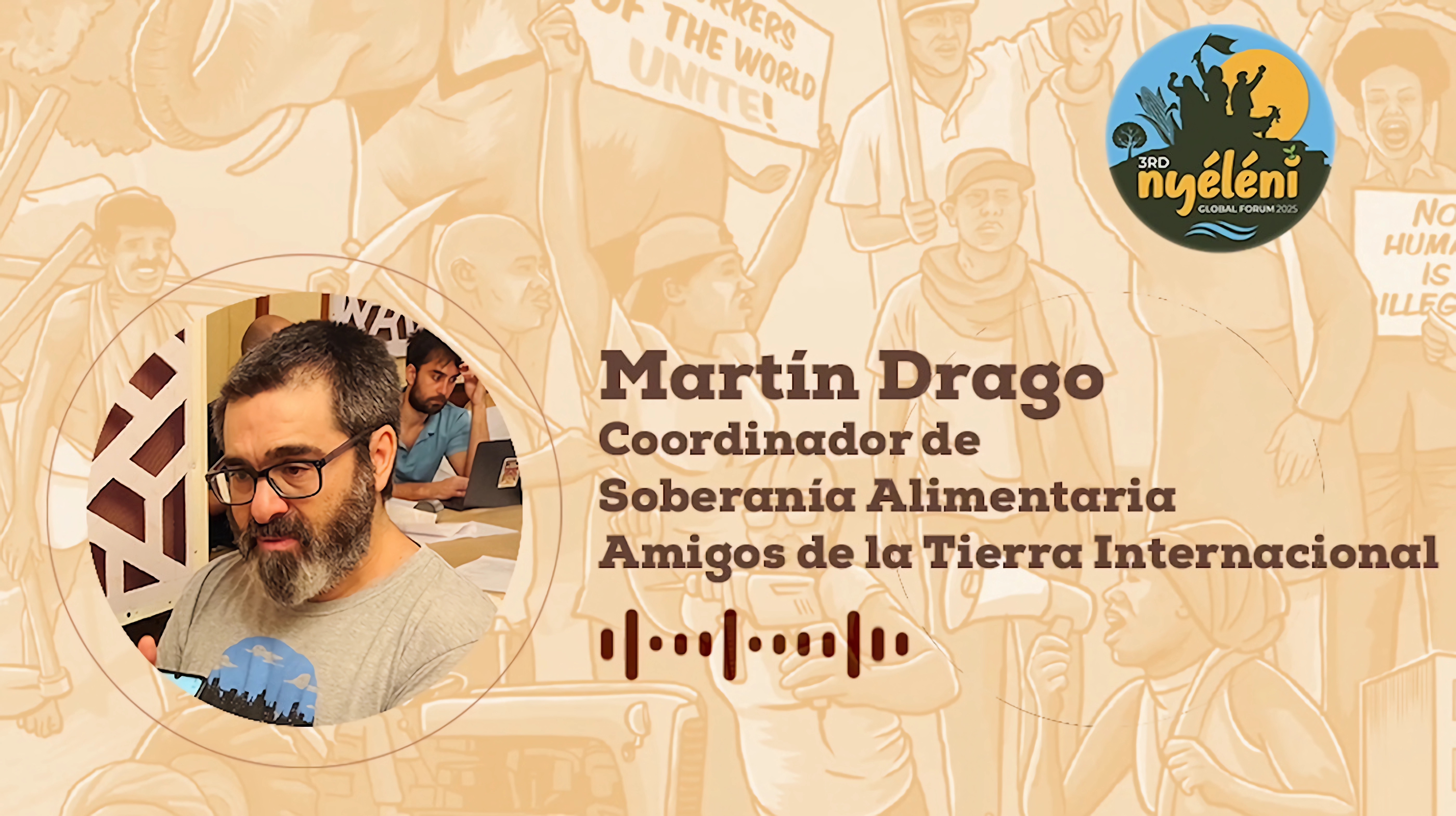

This interview with Martín Drago, coordinator of the Food Sovereignty program at Friends of the Earth International and member of the global steering committee, highlights what is at stake in this historic moment. For Martín, Nyéléni in Sri Lanka is not an endpoint but a milestone — a space to validate and advance a joint political agenda that dismantles oppression, resists fascism and neoliberalism, and puts democracy and the rights of peoples at the center. It is a call to deepen convergence across movements and regions, to forge hope in times of crisis, and to build the power needed for systemic transformation from the ground up.
“Nyéléni is a territory, a process, and a methodology for building convergences among social and popular movements and organizations — a process that seeks to dismantle all forms of oppression and exploitation, and to build a systemic transformative agenda from the local to the global.”
What is the 3rd Global Nyéléni Forum seeking? What is its value for the movements and social organizations that are pushing it forward from different continents?
Nyéléni means territory, process, and methodology for building convergences among social and popular movements and organizations. A methodology based on the principle of internationalist solidarity that functions through a horizontal dialogue of knowledge, rooted in the heritage, the patrimony, and the diversity of peoples, cultures, and struggles. It is a process that builds unity while strengthening regional organizational processes. That is the continuum, the accumulated history of Nyéléni. In 2007, the 1st Nyéléni Global Forum was a decisive milestone for the food sovereignty movement, because in that global forum a common characterization of food sovereignty was agreed upon, but also ideas, strategies, and actions to strengthen the global movement for food sovereignty and to promote and defend the proposal of food sovereignty. In 2015, there was a second decisive milestone of the food sovereignty movement, also associated with Nyéléni: the common characterization of agroecology and the strategies and actions to jointly promote and defend it. In this 2025, the 3rd Nyéléni Global Forum seeks to become a fundamental landmark in the articulation of social and popular movements and organizations, from the local to the global, to transform the system and dismantle all forms of oppression and exploitation. A process that seeks to go beyond the historical accumulation of the food sovereignty movement and, drawing on its know-how and its trajectory of building convergence, offer a methodology, a process, a territory for building convergences to other movements and struggles, in order to build that systemic transformative agenda that dismantles the different forms of oppression.
The 3rd Nyéléni Global Forum is part of this process of articulation, of building convergences. It is an agenda for systemic change and a very important moment, but it is not the end of the road, it is not the central moment of the process, but rather one more moment. It is a moment in which we will try to validate a joint political action agenda built on what unites us, but which will also identify nuances, including differences, that we will have to continue working on as we walk together. As we walk together to confront power, transnational corporations, and neoliberalism; as we walk together to resist the advance of fascism and the far right; as we walk together in defense of democracy as an indispensable condition so that politics and decision-making are in the hands and at the service of the peoples. And this also requires the construction of a new multilateral system, one that places the rights of peoples at the center, prevents transnational corporations and large military and financial powers from exercising and imposing their power and capturing decision-making processes, and that is capable of making respect for international legal order a reality.
The clearest failure of this multilateral system is what is happening with the genocide that the State of Israel is carrying out against the Palestinian people. The inability of this multilateral system to stop it is a clear sign of its failure. But this is also a process, a joint agenda that we will deepen as we walk together defending territories, defending the rights of peoples, while building, implementing, and expanding the emancipatory initiatives of peoples that, incorporating a feminist, anti-racist, anti-capitalist, anti-colonialist, anti-imperialist class perspective, bring us closer to social, environmental, economic, gender, and racial justice. This joint agenda also seeks to be deepened as we walk together toward the more radical implementation of internationalist solidarity.
A process that leads more and more social and popular movements and organizations to make their own and to accompany all struggles against injustice, oppression, and exploitation, no matter where in the world they take place, no matter how far they are territorially. So this is a very ambitious agenda. And to implement such an ambitious joint political action agenda, it is absolutely essential to progressively strengthen the convergence of more and more social and popular movements. In this, we understand that joint mobilization, both of resistance and transformation, as well as joint political education and joint popular communication will play a central role.
We need more and more social and popular movements and organizations, articulating resistance to the model from the local to the global and implementing and expanding emancipatory initiatives. And in this sense, the 3rd Nyéléni Global Forum will be a very important moment to deepen that articulation, to generate intersectional and intersectoral dialogues that allow us to better understand the struggles of others and to articulate resistance and transformation more effectively. But the Global Forum also seeks to be an important moment to give momentum to a vision of hope. In a world where the crisis feels so overwhelming, where the advance of the right and fascism feels so suffocating and its impacts on peoples and territories are so harsh, we need hope, a light, a light of hope, but also the political will of social and popular organizations to move toward the necessary transformations. And the Third Global Nyéléni Forum seeks to be a moment for that.
How is Friends of the Earth International preparing for this 3rd Nyéléni Global Forum? What has been its involvement and why is it so important for the federation?
The 3rd Nyéléni Global Forum will be a central moment and process in which Friends of the Earth International has been part of its genesis, which took place in 2018 in the framework of the assembly of the International Planning Committee for Food Sovereignty (IPC), that is, the global food sovereignty movement, in an assembly held in Cape Town. Since that moment, we have been involved in both the global and regional process: the global process in defining its principles, its characteristics, its global steering, in logistical matters, in communications, in methodological planning, and in building the joint political action agenda, with the aim of contributing the political, narrative, analytical, and propositional accumulation we have built together with our allies, and also based on the emancipatory initiatives that our national organizations, our regions, and Friends of the Earth International itself have been promoting and implementing in multiple and diverse territories.
What is the importance of the 3rd Nyéléni Global Forum in the current international political context?
The current political context is one of unprecedented turmoil. Capitalism, imperialism, patriarchy, racism, neocolonialism, militarism reinforce each other as systemic structures of oppression and have brought us to these profound and overlapping crises we are living today. We are facing an international crisis that is economic, social, democratic, ecological, health-related, patriarchal, and racist. In this context, we identify six trends. The advance of fascism and the far right as a project that disputes the social imaginary around a model of society to reorganize life in the service of the interests they promote, and which is an affront to the entire democratic system, even the one built on liberal consensus, since it mobilizes resentment and hatred against what they consider minorities, and also distorts or disputes the role of the state to privilege concentrated capital while presenting the state as the enemy of the popular classes. This “caste” discourse is a project that threatens any state that attempts to promote the realization of peoples’ rights. It is a project that criminalizes and persecutes the popular classes, that judicializes politics—in other words, it is an affront to democracy.
The second trend we identify is the strengthening of neoliberalism as a political narrative, as a political project that ensures the continuity of the accumulation of economic and political power of the global dominant class and the associated national elites. But it is also a project that, in order to advance, requires the militarization of territories, the rise of paramilitarism and private armies, war to appropriate natural resources, and so on. Moreover, it promotes the capture or corporate governance of the economy, of production, of politics, of government, of territories, of democracy, and even of multilateralism.
And here we also identify a third trend, which is the crisis of multilateralism. The UN no longer represents the interests of peoples, so it is very difficult to see how to regain a multilateralism that advances the rights of peoples, that guarantees access to justice, reparation, and non-repetition of the impacts of this militarism, of the advance over territories, of the wars for the appropriation of resources.
A fourth trend is this intensifying economic and debt crisis, which is also used to continue appropriating territories, for example, through debt-for-nature swaps.
The fifth trend is what we call disaster capitalism. The disasters caused by neoliberalism—whether natural, social, or political—are exploited by transnational corporations and the associated elites to continue accumulating economic and political capital.
And the sixth trend we identify is the growing control that technologies are having over different areas of life, even more so now with the advance of artificial intelligence. Here there is a central risk around who controls these technologies, and also around the new ways of knowing, such as artificial intelligence. And clearly, these are controlled by traditional corporations, large traditional corporations, but also linked to the political control of these technologies by that fascist project we mentioned earlier.
So, in this context that seems so bleak, protecting ourselves and resisting in the best way possible is central and requires strengthening popular organizational processes. But it also requires understanding that we will not find solutions within the dominant system and that no movement can ensure transformation, protection, or resistance on its own. Therefore, articulation and convergence to strengthen those organizational processes are central. The 3rd Nyéléni Global Forum, this process leading to the forum, the forum itself, seeks to be a space for strengthening those organizational processes, to be able to build popular power and provide effective responses to these crises we are facing. The Nyéléni process is an essential opportunity to build these convergences—analytical convergence, propositional convergence, but above all, convergence for joint political action, for mobilization to stop fascism, to stop the attacks on democracy, and to transform the system.
With over 500 delegates from 80+ countries expected, and interpretation into more than 17 languages, this forum will be a convergence of voices, movements, and visions for systemic change.
Listen now to the full conversation with Martin—also available on iVoox—and walk with us toward the forum in September.