

This year, Sri Lanka will host the 3rd Nyéléni Global Forum, a crucial gathering that will bring together participants from over 80 countries to strengthen the convergence of movements in building a common political agenda oriented toward popular power and the transformation of the capitalist, patriarchal, imperialist, colonialist, racist, caste-based, and supremacist system. Small-scale food producers, Indigenous Peoples, feminists, health and climate justice activists, along with defenders of the social and solidarity economy, will unite in this collective struggle.
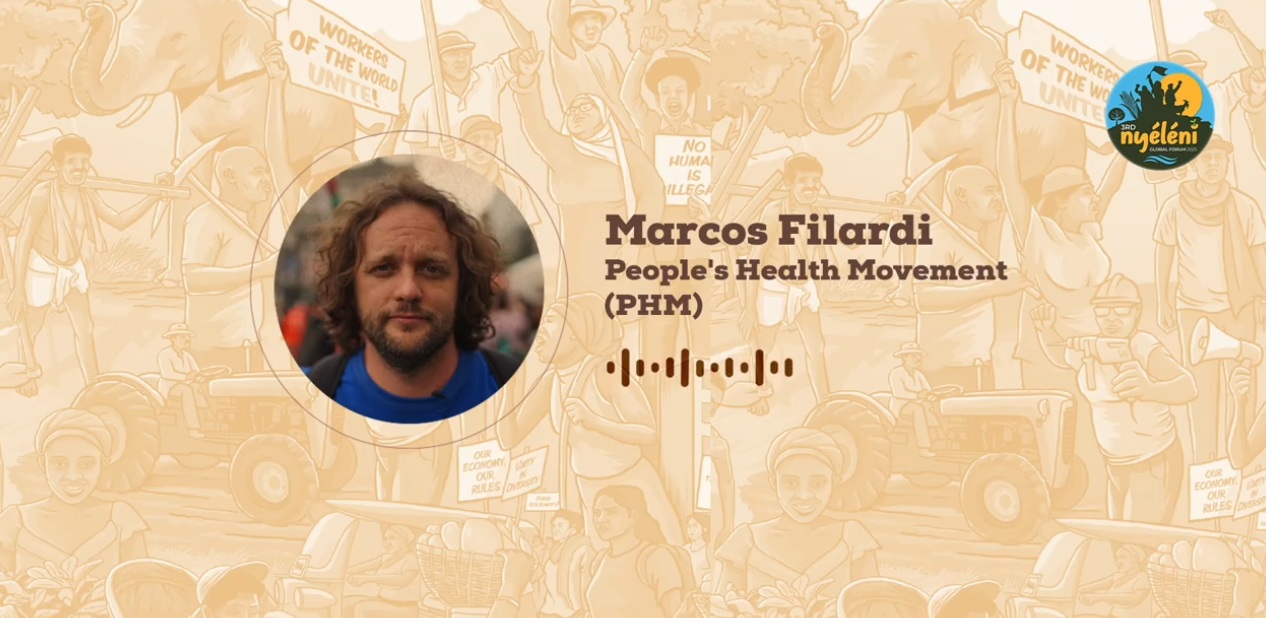
“We are the air we breathe, the water we drink, the food we eat. That is why it is absolutely necessary—and urgent—that we build a new relationship with the nature to which we belong. If we do not do this immediately, we are on a suicidal path… There is another way forward, another way to inhabit the territories where we live, in harmony with the nature we are and in harmony with other human beings.” — Marcos Filardi
We are resisting and building power from below, and this forum will be a spark in our collective struggle. In this context, how are the right to health and food sovereignty intertwined?
To achieve health for all, we must address food as the greatest determinant of health. In this regard, the dominant food system, controlled by large corporations, has endangered the lives of marginalized communities through the mass production of ultra-processed foods and the indiscriminate use of agrochemicals. Agribusiness, designed to generate profits rather than to nourish, causes hunger and disease. Eight hundred million people go hungry, and 2.5 billion lack access to adequate food. Furthermore, agrochemicals—present in the air, water, and food—cause severe health problems in both rural and urban areas, ranging from cancers to reproductive disorders.
How do feminism and agroecology relate to offer a holistic approach in the struggle for food sovereignty?
The fight for food sovereignty is deeply linked to gender justice. Feminism is an integral part of the agroecological movement because the right to health includes the right to land and the right to freely control our bodies. This approach challenges the patriarchal model that dominates social relations and the control of bodies and territories, incorporating an intersectional perspective into the struggle.
What consequences does the current agroindustrial system have on health and the planet?
The agroindustrial system and industrial meat production affect not only human health but also biodiversity and the future of the planet. The massive use of antibiotics in production animals has triggered an antimicrobial resistance crisis that already causes 1.4 million deaths annually. The current food system is making us sick and killing us. We urgently need structural change toward systems that produce healthy and nutritious food, in harmony with nature.
What does the Third Global Nyéléni Forum represent, and what is its call to grassroots social movements?
The Third Global Nyéléni Forum is much more than a meeting; it is a call to walk together toward a just, dignified, and sustainable system. Enough with an economy for a few. It is time to nourish our lives with food sovereignty, decent incomes, and justice for all.
With over 500 delegates from more than 80 countries expected and interpretation in more than 17 languages, this forum will be a convergence of voices, movements, and visions for systemic change led by the peoples.
🎧 Listen now to the full conversation with Marcos Filardi (in English only)—also available on iVoox—and let us walk together toward the forum this September.