
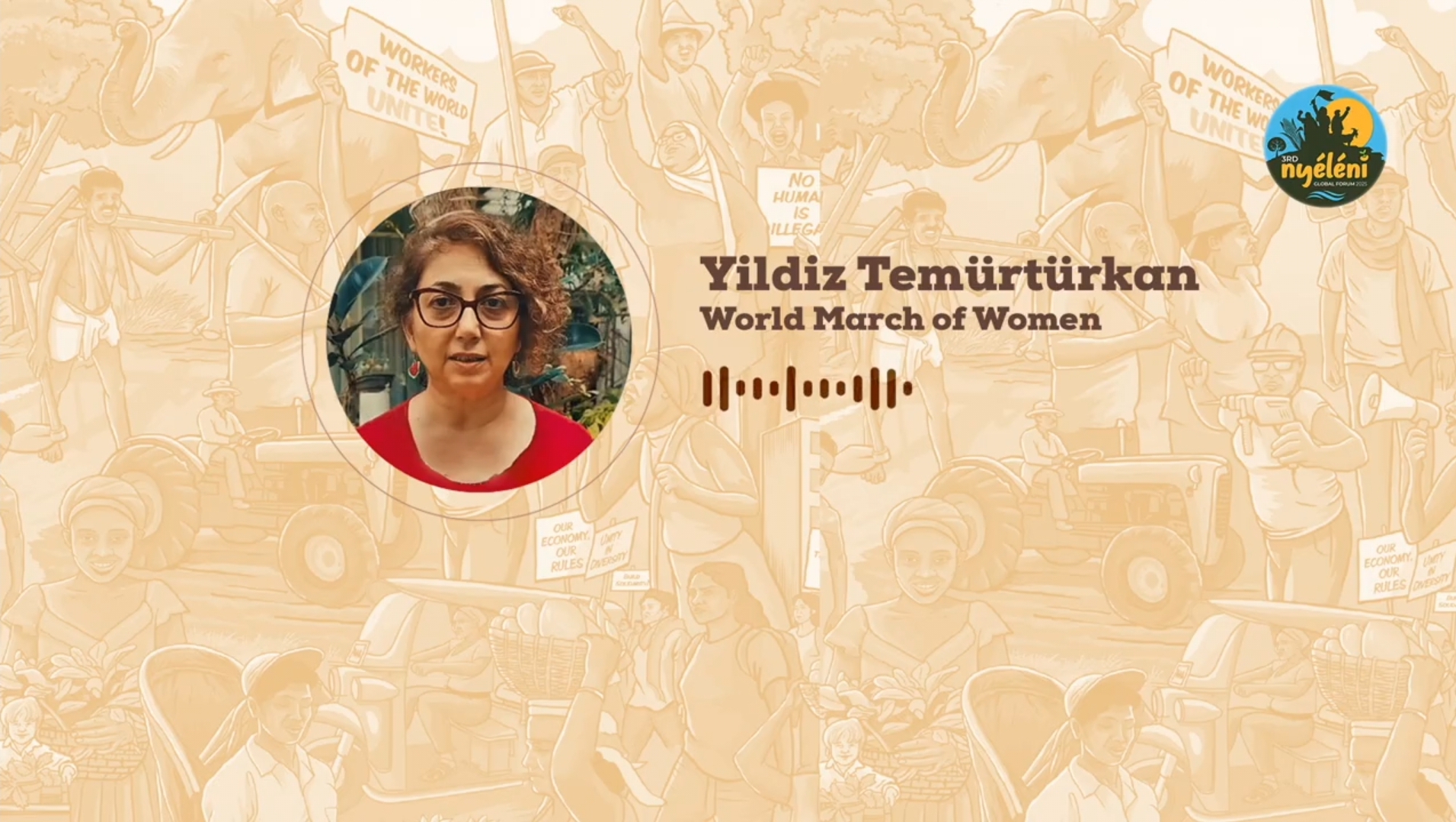

Across territories marked by war, occupation, and corporate exploitation, women are at the forefront of defending self-determination, building alternative media, and creating peace with justice. In this interview, Yıldız Temürtürkan, international coordinator of the World March of Women, shares stories of feminist resistance — from Kurdistan to Palestine, Western Sahara to the Congo — where local struggles connect to global solidarity. Read and listen to the full conversation.
Can you introduce yourself and your organization?
I am Yıldız Temürtürkan from Turkey and I have been part of the World March of Women (WMW), an international feminist movement, since 1998. Recently, I am the International Coordinator of the WMW. We are based in Ankara, Turkey, where our International Secretariat Office is currently based.
How is the right to self-determination lived in your community without impositions from above or from outside? And if you could share with us a story where people took back control over an important decision.
Personally, I come from the anti-imperialist revolutionary youth movement formed after the military regime in Turkey. Self-determination is very important for the peoples living in our territory right now. 100 years ago we had the experience of liberation war and our country was established following a big liberation war as an occupied territory by the foreign armies of imperial powers. It was a result of a big resistance. Today at the grassroots level the women who are fighting against transnational corporations see this moment as new liberation war. It happened with armies 100 years ago but today they occupy our territory with the power of capital and with transnational corporations. So we can see how deep rooted is our self-determination desire to be independent from imperial powers. On the other hand, we have other peoples living in our territory, like Kurdish people who have been struggling for 50 years for their self-determination rights recognised and have paid a high price on the way. As the Turkish left movement we have always been in solidarity and supported other people’s right to self-determination.
In a world where the big media control public opinion, how have you strengthened the people’s voice and resisted fear and misinformation?
We always complain not to have access to true information especially on issues from Afghanistan, Syria and Iraq because all the information comes through western mainstream media that is supportive for their government’s positions. So it´s really hard to reach the correct information because what is generally coming from social media is manipulated, hence the actions or strategies adopted based on the information coming from social media results mostly in failure. So it´s very important to create our own alternative media. In Turkey, the media is the pro government one, it´s very partisan under control of an authoritarian government. We have alternative media but it´s being criminalized and silenced. Luckily in this age of digital technologies it is difficult to silence alternative voices, so it is important to organize it.We have a good experience in this field which is Capire (capiremov.org) Capire means to understand. We try to understand the world through the eyes and voices of grassroots women who are in resistance, in struggle and in solidarity.It echoes the voices of women in the movement, publicize the struggles and organizational processes from the different territories. So it’s a good example of a multi-language website. I would advise you to visit frequently and hear stories from the grassroots woman from all over the world.I also really recommend to follow Capire’s web because they have interviews and speeches from women from all over the world. So, congratulations on that sense to the World March of Women.
What does peace mean to you? Not the peace of the powerful, but the peace with justice. Have you been part of any grassroots peace building process you would like to share?
Yes, since my childhood we have been inside peace initiatives in our country because of the war with Kurdish people who want equal rights and citizenship. This means that we have been involved in peace initiatives which are difficult and challenging. Also, at the international level from our experiences inside the World March of Women we drafted a good document with the participation of women from all over the world, which was adopted in 2004. The Women’s Global Charter for Humanity has five values: equality, freedom, solidarity, justice and peace. As it is described, peace is achieved especially as a result of equality between women and men, social, economic, political, legal and cultural equality, protection of rights, eradication of poverty, ensuring that all people live in dignity, free of violence, ensuring that everyone has employment, enough resources to eat, house, clothes, and educate themselves, and it means protection in old age and access to health care. So, this is the broad meaning of what we understand as peace. Since 2005, peace and demilitarization is one of our axis of global action. Especially from 2010, when the Global Feminist Action happened in the DRC, the Democratic Republic of Congo, for the first time in a conflict country. It was a really important experience that inspired our action in Turkey, when our feminist caravan began from the border with Syria in 2015, that divides the Kurdish territory in a year of war in that region. We took feminist action outside the big metropolis. Recently in Antakya, at the border with Syria, we had an action and debated the situation of woman in Syria and the genocide of the minorities where woman are subjected to rape and violence. In this year we are planning another action on September 21st which is the World Day for Peace. We will have international gathering in Nepal for peace and demilitarization. Our slogan for the current Global Action is: We march against wars and capitalism, we defend people’s sovereignty and Buen Vivir. Peace is very important in our actions because women are the important forces struggling against wars and also fascisms all over the world.
How do you organize in your territory to break isolation and reclaim politics as a tool for collective transformation?
As an international feminist organization, we have an important tool. To break the isolation it is important to articulate local struggles to the global ones. To break isolations of the local struggles. Unfortunately, the major struggles in Turkey against transnational companies, against extractivism, for food sovereignty, to protect the waters, rivers are very local. Not only in Turkey, we say the same pattern in Eastern Europe and in the Balkans, so it´s important to organize a network of the struggles. It is very difficult and long-term process. In fact, it’s not that easy to work from local to global level, but this it seems this is the only way to break the isolation and help their articulation to the global movements. Today many communities around the world live under occupation or war.
How do you build international solidarity from where you are? Are there any gestures you’ve received or offered that left a deep impression in that sense?
The local struggles in those countries are important. If the people are struggling then it is easier to bring people to organize solidarity. For example in Palestine, as the Palestinian people do not give up struggling over 70 years against occupation. So they are a good symbol of people all over the world.We can organize solidarity action because they are concretely in the struggle. It is important to make them visible first, at global level. Another example is what happens in Western Sahara. This year the launch of our international action on March 8th was in Western Sahara together with Sahrawi women. It is very impressive how they live in the desert in the south of Algeria for more than 50 years and the women’s stories and how many of them are educated in foreign countries and go back to live in this territory because it is about dignity. We´re also in solidarity with Kanak people at international level in New Caledonia, an ongoing process and they continue anti-colonial struggle there. A lot of criminalization happening that avoids also the Kanak woman to articulate to international processes. They cannot communicate freely and safely. Also the situation in Syria that has a big impact in our life in Turkey. We organize also solidarity with the countries suffering from sanctions and blockades. Sometimes we organize anti-imperialist week and to bring the voices from those countries to explain how those imperialist and militaristic policies affect their lives.
Could you tell more about the struggle for Palestine, are you organizing in a concrete way inside the World March of Women to support the struggles there to be present at some level?
Since October 7th, last year and this year we organized the global action on March 30th which is the Land Day of Palestine and so it is a very important day. This date is also important in Turkey, when revolutionary leaders were killed and they also had training in the Palestinian guerilla camps in the 1960s. So we had very close links in Turkish revolutionary movement with Palestine. And they did some actions to show their solidarity. It is something inherited from the leadership of the revolutionary movements to our generation. We always felt ourselves in solidarity with Palestine. Every year we organize actions. Previously we were generally disseminating solidarity statement but this last year we thought it is not enough we need to start mobilizing the woman in different territories to express their solidarity with Palestine. Also we have some publications to explain for the young woman and young generation what is the question of Palestine.
Do you have a concrete example of popular resistance that combines struggle and creation or creativity? What did that process teach you about changing the system from the ground up?
We learn a lot during the process of the International Feminist Organizing School (IFOS) named after Berta Cáceres. During the pandemic, we had this experience. It was a good process when we were all isolated in the houses during the pandemic. In fact, we could meet and that made us connected although it was online. More than 100 women all over the world participated. We discussed systems of oppression and Mother Earth, Feminist Economy, how to build ourselves as a movement we discussed all issues from different experiences. We learned from the memory of our people and what they did to survive during the time of crisis and also we learned a lot from indigenous woman and the relation between body and territory. We acknowledge and appreciate their wisdom and their way of living and consider them as our teachers.
🎧 Listen now to the full conversation with Yildiz Temürtürkan (in English only)—also available on iVoox—and let us walk together toward the forum this September.