
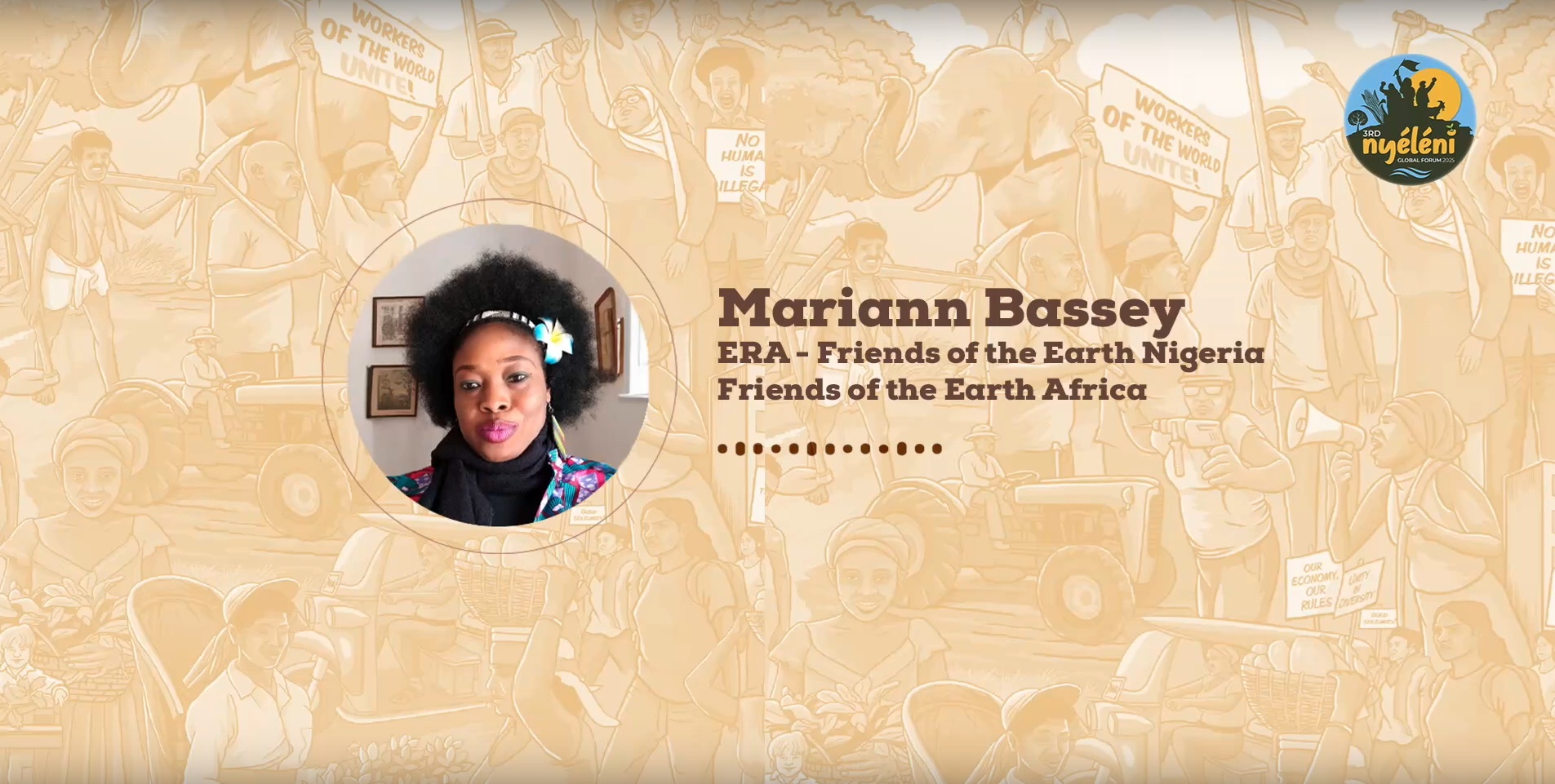

Food is more than what ends up on our plates—it carries culture, identity, and the wisdom of generations. At the heart of the 3rd Nyéléni Global Forum, delegates from all over the world gather to share stories, strategies, and visions for a just and sustainable food system. In this conversation, we hear from Mariann Bassey, who represents the African region and the Respect and Diversity group at the 3rd Nyéléni Global Forum, about how these principles connect to food sovereignty, the power of communities to resist corporate control, and the ways traditional knowledge continues to shape the fight for nourishing, culturally rooted food.
We are members of this great movement from diverse groups, but we are united by one vision – a very clear vision for a just transition towards a transformative food system that takes into cognisance our small-scale farmers and peasants.
How does the work of the Respect and Diversity group at the 3rd Nyéléni Global Forum connect with the struggle for food sovereignty?
The Respect and Diversity Working Group is like a task force to ensure that the Nyéléni Forum is a safe space for everybody’s voice to be heard and for the struggles we are facing in our local communities, our constituencies and our continents to be expressed in a respectable manner and where people are heard.
Food is not just about eating, it also has to be respected and for that there has to be respect for the people. So there needs to be some rules and protocols to make sure in the Forum everyone understands that there are different diversities and identities which we treat and we respect. Everybody has a right to be heard and that we are coming here to actualize one goal: a transformative society and transformative food. This starts with ourselves to respect our boundaries and limits to have discussions in a transparent and respectable manner.
What you’re saying really translates into this much more complex vision of food sovereignty that goes beyond food. It’s about a model of society that we want to build, right?
Yes, it’s a model of society where nobody is excluded. Historically, some people have been excluded, and these people have shaped our victories and policy wins. This has helped us to build very strong movements. We feel all the voices matter. Everybody has a say, everybody has something to contribute. Everybody comes from their lived realities and experiences. We feel that by joining these different experiences from where we live, from our identities and the things that we’ve done, we will be able to achieve our goals of a transformative society and a just system. A system where people eat the food they want, in the way they want it, in the quantity they want it and which is culturally acceptable to them. Where nobody is forced to just eat anything because they are hungry. Above all that those who produce this food, the farmers and peasants, are respected and accorded the acknowledgment? they deserve.
In this in in this picture you’re painting for us, how does corporate power play a role in perpetuating exclusion of different categories of society?
I think that the corporate society plays a role and historically people’s beliefs also play a role. The corporations have to profit, so by dividing people they can achieve their goal. They don’t want people unified. So they are coming with different narratives to ensure that people are divided. When people are divided they leave the main fight
Some of our governments also are sometimes mainly after money, they are not looking after the people. Mostly for them it’s about profit too, smiling to the bank. I think it’s a deliberate plot, a direct systematic breakdown of our food and people to ensure that people stay divided. That even this type of conversation isn´t possible.
The past week has been powerful, empowering and inspiring with different people from diverse backgrounds, different continents and identities coming together to shine light on the kind of food we want to eat. For food sovereignty, which has agroecology on the forefront.
The corporation do not want this kind of order, what they want is a broken system where they will continue to feed us with chemicals and pesticides. If you come and start modifying my food and polluting it, it’s no longer the food that I know. It is something else. They need to do that to keep the business going. It’s nothing about our food, it’s nothing about food sovereignty. It has nothing to do with feeding the people. It has to do with growing their empire that is built on deceit and falsehood.
Can you name any examples from Africa that we can lean on for inspiration of current struggles that have given fruits?
Yeah, there’s been a lot of victories from different African countries, like with the Alliance of Food Sovereignty Africa. Over the years we’ve produced more than 200 case studies to show that agroecology is the way to go. It’s a bold transformation to end famine. We’ve seen communities that were dead. Farm lands that were dead and through agricultural practices they were able to change this. In the Tigray region of Ethiopia the land was regenerated and it’s growing very well. In Nigeria we’ve had battles with the corporations where they’ve tried to put the paradigm of genetically modified foods as the silver bullet.
There have been different processes in Kenya. They were able to win a case against GMOs in court. It was a fierce battle and in the end there was a declaration in favour of the people, which shows that sometimes we battle and feel like nothing comes out of it, but eventually truth and victory prevail. We feel that the victory for one is a victory for all. When the people are victorious in one country and have a success story, that´s a turnout for other people to follow. So when our comrades win these battles, we are happy.
What is really happening now is that children no longer want to eat local food. They want to eat food from big food chains. The traditional food, which is very nourishing, they don’t want to eat. You know, the companies have the money, they do big advertisements, they go to schools with food program and they´re trying to gradually erode our traditional practices.
Our food is medicinal. That is why when we had COVID, even though the vaccines came to us late and we couldn’t travel, we didn’t die. Our food became medicine and medicine became the food because there was only the food we grow around us. Traditionally, African food is very healthy. It has everything you need. It starts from the inside. Once your food is contaminated or polluted, it´s like poison to your system.
That´s why, as a person, if you take something your body doesn´t agree to, you are hurt, you become sick. That´s why for us food isn´t just food, it´s the whole of our existence. If you go anywhere in the world and somebody brings you food, you know where it’s coming because the food is an identity. If you bring me matoke, it´s bananas, that is their staple food in Kenya. Come to Nigeria, I give you di kai kong, starch and banga. Food is involved in all our cultures, in all our events, from birth, marriages to death, there must be food. For us, it’s not just something we eat, it is an unifying force.
In our family we try to have one meal together, where people share, discuss, eat and it´s a very important bond that builds communities. People in communities cook together, someone brings rice, another leaves, another pepper. People contribute, they are cooking, eating and sharing stories. It’s very beautiful traditions that we don’t want to perish and ever go away because that is how you pass on generational knowledge. It’s not like a formal school where you teach, it’s true and relaxed conversations while laughing and speaking. You always remember those stories. From your auntie, from your grandma, from your elder sister, from the women you came before. They tell stories.
There is a whole of things in food sovereignty that we need to protect and guard. We don´t want the corporation bringing their paradigm, everything they do is about money and control.
From what you explain, this knowledge has been handed down from one generation to another in the kitchen from sharing meals that are outside of the corporate food system, right? With the Nyéléni Forum coming up, what would you wish to come out that would help these struggles you’ve been a part of?
Nyéléni is like a community itself. It’s different people, even where it´s going to be held, in a village at the center that is build by the people, it was chosen carefully and built with love to help the people. You see people coming from all works of life, from north, south, east with a single purpose: sharing stories and trying to forge a path with the fertilization of ideas. People speaking and contributing to the objective of building a truly transformative system that is forced on us. So Nyéléni is all about a just food system built on respect and respecting the modes of production where people have the right to eat what they are used to. That is culturally appropriate, sustainable and nourishing. We’re talking about real nourishing food and with this food come stories.
In food sovereignty, food is at the center of everything. So we are trying to connect the dots and ensure that every system of production and everything connected to our food, the climate, the energy, is sustainable. We have a next generation to think about.
People who came before us handed a legacy of goodwill. It should not end with us. That is what unity is all about. Our leaders should also listen to us. It shouldn’t always be profit over people.
Nyéléni is about unifying voices and inclusion. It is about valuing our systems, about human rights and non-discrimination. About bringing in people to celebrate victories and share strategies.
With over 500 delegates from 80+ countries expected, and interpretation into more than 17 languages, this forum will be a convergence of voices, movements, and visions for systemic change.
Listen now to the full conversation with Mariann—also available on iVoox—and walk with us toward the forum in September.